







What's Happening?
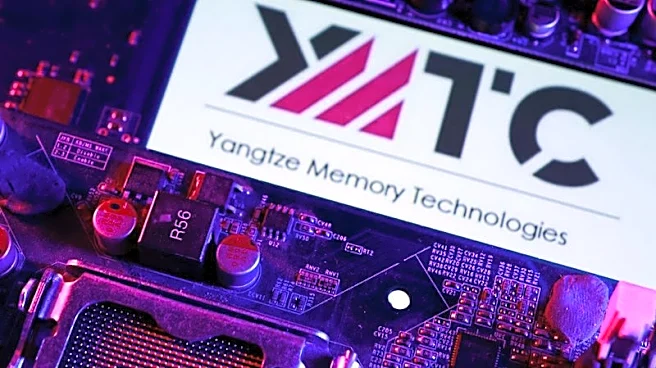
Yangtze Memory Technologies (YMTC) is reportedly planning its fourth NAND factory in Wuhan, aiming to produce 3D NAND with over 300 memory layers. This ambitious project signifies a major technological advancement for the Chinese semiconductor industry.
According to Reuters, YMTC intends to source at least 60%, and potentially up to 70%, of its production equipment from Chinese manufacturers. This represents a significant increase from its third factory, where slightly more than half of the equipment is expected to be domestically sourced. The new facility, slated for construction in 2027, will focus on high-density NAND memory for data centers and artificial intelligence applications. YMTC was placed on the U.S. Department of Commerce’s Entity List in December 2022, subjecting certain U.S. technology supplies to additional licensing requirements.
Why It's Important?
This development is crucial as it directly reflects China's intensified efforts to reduce its dependence on foreign semiconductor technologies, particularly in response to U.S. export restrictions. By aiming for over 300 memory layers, YMTC is pushing the boundaries of NAND technology, potentially surpassing the layer counts of some international competitors' current plans in China. The increased reliance on Chinese-made equipment, such as from Naura Technology and Advanced Micro-Fabrication Equipment (AMEC), indicates a growing domestic supply chain capability. This could significantly alter the global NAND market dynamics, potentially leading to increased competition and shifts in market share. For the U.S., this signifies the effectiveness of its export controls in spurring China's indigenous technological development, which could have long-term implications for U.S. dominance in the semiconductor industry.
What's Next?
While the plans are still in early stages, with no binding orders placed, the successful implementation of this factory would mark a significant milestone for China's semiconductor self-sufficiency. The key challenge will be whether Chinese suppliers can provide reliable and competitive equipment for the most demanding manufacturing steps, especially in areas like lithography and metrology where foreign technologies currently dominate. If YMTC proceeds with its planned additional factories, it could substantially increase its production capacity, potentially impacting global SSD prices and market availability. The U.S. will likely continue to monitor these developments closely, potentially adjusting its export control policies in response to China's progress in domestic semiconductor manufacturing. The focus will be on whether China can achieve true technological independence in critical areas.
Beyond the Headlines
The deeper implication of YMTC's plans is the acceleration of a bifurcated global semiconductor ecosystem. As U.S. export restrictions push China to develop its own advanced manufacturing capabilities, the world may see two distinct supply chains for critical technologies. This could lead to increased costs, reduced interoperability, and heightened geopolitical tensions. The ethical dimension involves the balance between national security and global technological collaboration. While the U.S. aims to prevent its technology from being used against its interests, these restrictions inadvertently foster a more self-reliant, and potentially competitive, Chinese tech industry. This long-term shift could reshape global trade patterns, intellectual property landscapes, and the future of technological innovation, with both nations vying for leadership in critical sectors like AI and data storage.