





What's Happening?
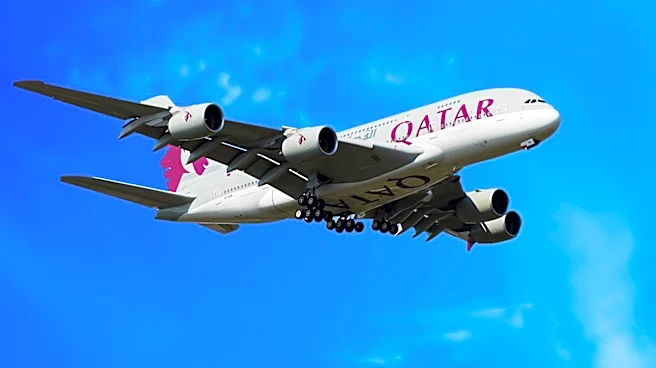
Qatar Airways has announced a new partnership with Uber for Business, aiming to enhance its corporate travel offerings. This collaboration is the first of its kind in the Middle East and North Africa region, integrating premium air travel with on-demand
ground transportation. The initiative is designed to streamline global business travel by allowing members of Qatar Airways' Beyond Business corporate travel program to convert Qrewards into Uber ride vouchers. These vouchers are credited directly to a user's personal Uber wallet and can be used for business travel worldwide. The airline stated that this integration extends its premium corporate offering beyond air travel, providing businesses with greater flexibility in managing end-to-end journeys and offering corporate travelers priority services and seamless access to ground transportation. This partnership builds upon Qatar Airways' recent recognition as 'World's Best Airline' for the ninth time at the 2025 World Airline Awards by Skytrax, and its continued efforts to enhance customer experience.
Why It's Important?
This partnership is significant for the corporate travel sector, particularly for businesses operating in or with connections to the Middle East and North Africa. By integrating air and ground transportation, Qatar Airways and Uber for Business are addressing a key pain point for corporate travelers: the often-disjointed experience of managing different segments of a business trip. The ability to convert Qrewards into Uber vouchers offers a tangible benefit for companies, potentially reducing travel expenses and simplifying expense reporting through Uber for Business's centralized dashboard. This move could set a new standard for corporate travel programs, encouraging other airlines and ground transportation providers to explore similar integrations. For U.S. businesses with international operations, this partnership could offer a more efficient and cost-effective way to manage employee travel, improving overall productivity and traveler satisfaction. It also highlights the growing trend of loyalty programs extending their value proposition beyond their core services.
What's Next?
The immediate next step for Qatar Airways and Uber for Business will be the implementation and promotion of this integrated service to corporate clients. Businesses enrolled in Qatar Airways' Beyond Business program will begin to utilize the Qreward conversion to Uber vouchers. It is likely that both companies will monitor the adoption and feedback from corporate travelers and travel managers to refine the offering. This partnership could also serve as a blueprint for future collaborations between airlines and ground transportation services in other regions, potentially leading to a more interconnected global travel ecosystem. Competitors in both the airline and ride-sharing industries may observe the success of this integration and consider developing similar partnerships to remain competitive in the corporate travel market. The focus will be on demonstrating the value proposition of seamless travel management and cost efficiency to attract more corporate clients.
Beyond the Headlines
Beyond the immediate benefits of streamlined travel and cost management, this partnership reflects a broader shift in the travel industry towards integrated, personalized, and technology-driven solutions. It underscores the increasing expectation from corporate clients for end-to-end travel experiences that are not only efficient but also rewarding. The use of loyalty points (Qrewards) for ground transportation signifies a blurring of lines between different segments of the travel industry, moving towards a more holistic approach to customer value. This could lead to a future where travel ecosystems are highly interconnected, with various services seamlessly integrated through digital platforms and loyalty programs. Furthermore, the emphasis on a centralized dashboard for corporate travel managers highlights the growing importance of data and analytics in optimizing business travel, enabling better oversight, policy enforcement, and cost control. This trend could ultimately redefine how businesses manage and perceive their travel expenditures.