






What's Happening?
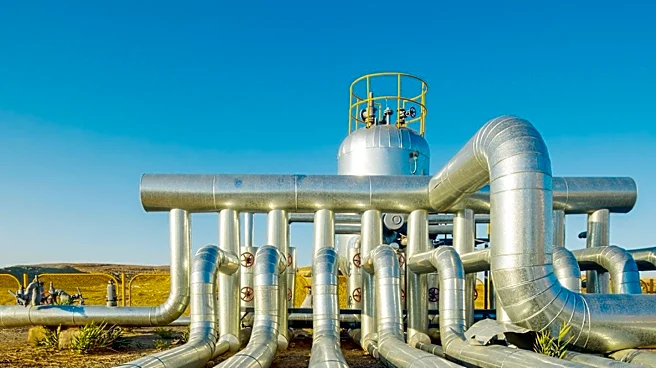
The Solitude Pipeline System joint venture has announced a positive Final Investment Decision (FID) to construct two 48-inch natural gas pipelines. These pipelines will transport gas from the Permian Basin to Katy, Texas, on the Gulf Coast. The joint venture comprises
WhiteWater (50.0%), Devon Energy Corporation (25.0%), MPLX LP (10.0%), Diamondback Energy, Inc. (7.5%), and Western Midstream Partners, LP (7.5%). The project has secured substantial long-term firm transportation agreements with predominantly investment-grade shippers, which supported the FID. The Solitude system is designed for flexible, phased development, with an initial capacity of approximately 2.25 Bcf/d expected in late 2029, followed by an additional 2.25 Bcf/d in 2030. The capacity can be further increased to meet future shipper demand, and commissioning can be adjusted based on market dynamics. The system is anticipated to commence service in the second half of 2029, pending customary regulatory and other approvals.
Why It's Important?
This Final Investment Decision for the Solitude Pipeline System is a significant development for the U.S. energy sector, particularly for the Permian Basin and the Gulf Coast. The Permian Basin, a major oil and gas producing region, requires robust infrastructure to transport its growing natural gas output to market. The new pipelines will provide scalable, long-haul transportation, addressing potential bottlenecks and supporting continued production growth in the basin. For the Gulf Coast, the increased supply of natural gas will cater to expanding consumption, including demand from LNG export facilities and industrial users. The involvement of major energy companies like Devon Energy, MPLX, Diamondback Energy, and Western Midstream Partners, along with the backing of investment-grade shippers, underscores the project's strategic importance and financial viability. This infrastructure investment is crucial for maintaining energy security, facilitating economic activity in both regions, and strengthening the U.S.'s position as a global energy supplier.
What's Next?
The Solitude Pipeline System is expected to enter service in the second half of 2029, contingent upon receiving all necessary regulatory and other approvals. The phased design allows for an initial capacity of 2.25 Bcf/d by late 2029, with an additional 2.25 Bcf/d coming online in 2030. The joint venture retains the flexibility to accelerate or defer capacity commissioning based on evolving market conditions and shipper demand. This adaptive approach will enable the project to respond to future changes in natural gas production and consumption patterns. The construction phase will involve significant engineering and logistical efforts, creating jobs and stimulating economic activity in the regions traversed by the pipelines. The successful completion and operation of the Solitude Pipeline System will further integrate the Permian Basin's natural gas supply with the Gulf Coast's demand centers, enhancing the efficiency and reliability of the U.S. natural gas market.
Beyond the Headlines
The Solitude Pipeline System's development highlights the ongoing strategic importance of natural gas infrastructure in the U.S. energy landscape. As the nation continues to transition its energy mix, natural gas plays a crucial role as a cleaner-burning fossil fuel and a bridge to renewable energy sources. The project's ability to deliver scalable, long-haul transportation from a prolific basin like the Permian to the industrial and export hubs of the Gulf Coast underscores the interconnectedness of regional energy markets. This investment also reflects the long-term commitment of major energy players to natural gas, despite increasing pressures for decarbonization. The project's success will not only impact the economics of natural gas production and distribution but also influence U.S. energy policy, trade balances, and environmental considerations. It represents a significant capital deployment in critical infrastructure that will shape the energy future of the country for decades to come.