







What's Happening?
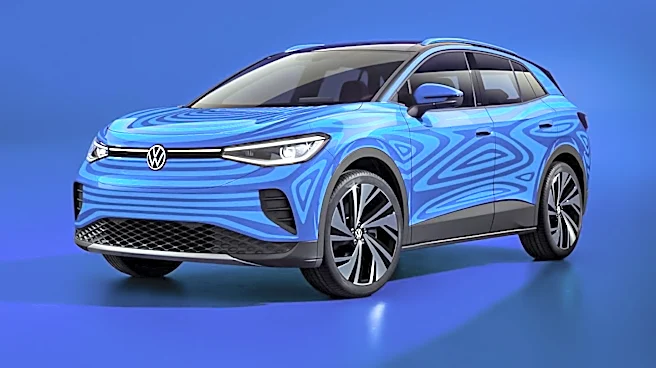
The Volkswagen ID. Cross, an electric compact SUV, is slated for production in Europe by late 2026 but is currently not confirmed for the U.S. market. The vehicle, built on an updated MEB+ platform, is a front-wheel-drive model measuring approximately
163 inches long. It will be offered with 37-kWh and 52-kWh batteries, providing up to 211 horsepower and an estimated 265 miles of European WLTP range with the larger pack. Charging capabilities will top out at 105 kW. These specifications, particularly the compact size, front-wheel-drive configuration, and range, are considered less competitive for the American market, which typically favors larger SUVs with all-wheel-drive options and longer ranges. Volkswagen has not officially announced plans to bring the ID. Cross to the United States, citing the significant investment required for a small vehicle in a market that has historically been challenging for such models.
Why It's Important?
Volkswagen's hesitation to introduce the ID. Cross to the U.S. market reflects a broader challenge for automakers in tailoring electric vehicle offerings to diverse global consumer preferences. The American market's demand for larger, more powerful, and often all-wheel-drive SUVs creates a barrier for smaller, more economical EVs designed for European tastes. This decision could impact Volkswagen's overall EV strategy in the U.S., potentially limiting its ability to capture a wider segment of the electric vehicle market, especially if it misses out on consumers seeking more affordable or compact electric options. It also highlights the economic realities of vehicle importation, including emissions certification, safety requirements, transportation costs, and tariffs, which can make bringing certain models to the U.S. financially unfeasible without sufficient projected demand. The absence of the ID. Cross could leave a gap in Volkswagen's U.S. electric lineup, potentially ceding market share to competitors offering a broader range of EV sizes and capabilities.
What's Next?
While the Volkswagen ID. Cross is set for European production in late 2026, its future in the U.S. remains uncertain. Volkswagen would need to assess potential demand, consider significant modifications like increased range and the addition of all-wheel drive, and justify the substantial investment required for U.S. market entry. Without these adjustments and a clear business case, it is unlikely to appear on American shores. However, the design language of the ID. Cross might influence future Volkswagen models developed specifically for the U.S. market. The company will continue to focus on its existing and planned EV offerings for the U.S., which are more aligned with local consumer preferences for larger vehicles. Industry observers will watch to see if Volkswagen re-evaluates its strategy for smaller EVs in the U.S. or if it continues to prioritize larger SUV segments.
Beyond the Headlines
The decision regarding the Volkswagen ID. Cross underscores a fundamental divergence in automotive market trends between Europe and the United States. European markets often prioritize efficiency, smaller footprints, and urban maneuverability, while the U.S. market leans towards larger vehicles, perceived utility, and longer-range capabilities, even in the EV segment. This disparity forces global automakers to make strategic choices about which models to localize and which to restrict to specific regions, impacting global product portfolios and manufacturing efficiencies. The reluctance to bring the ID. Cross to the U.S. also reflects the ongoing challenge of convincing American consumers to embrace smaller electric vehicles, even as environmental concerns grow. It highlights a cultural preference for larger vehicles that continues to shape automotive offerings, potentially slowing the adoption of more compact and efficient EVs in the U.S. compared to other parts of the world.