






What's Happening?
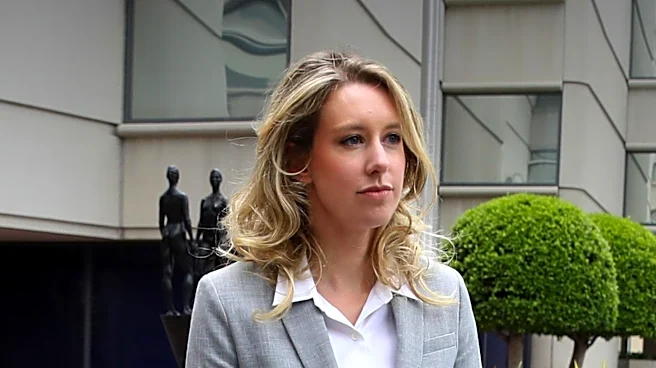
Photographer Benjamin Rasmussen recounted his 'unsettling' experience photographing Elizabeth Holmes at Theranos headquarters in Palo Alto, California, in 2015 for a Bloomberg Businessweek cover story. The assignment aimed to capture Holmes's response
to a Wall Street Journal investigation that raised suspicions about her health-tech company. Rasmussen and his assistant, Ryan Brown, were instructed to take simple portraits on a white backdrop to reveal the 'real' Holmes. However, they encountered a highly controlled environment orchestrated by a PR team in crisis mode. The directive was for group portraits only, featuring a specific group of all-women scientists, which Rasmussen perceived as an attempt to pivot the narrative towards a 'team effort.' He noted the room was messy and stacked with cardboard boxes, and despite being a lab setting, it didn't appear particularly controlled or sterile, raising his suspicions about the authenticity of the scene.
Why It's Important?
Rasmussen's account offers a unique, behind-the-scenes glimpse into the carefully constructed facade of Theranos and Elizabeth Holmes during a critical period. His observations highlight the extent to which Holmes and her team went to control public perception, even as the company faced serious allegations. The photographer's struggle to capture an authentic image amidst a highly managed environment underscores the deceptive practices that ultimately led to Holmes's conviction for criminal fraud. This story is important because it provides a human perspective on the corporate deception, illustrating how even seasoned professionals can be misled by carefully curated appearances. It also sheds light on the role of media and public relations in shaping narratives, particularly in high-stakes business environments where image can be paramount to maintaining investor confidence and public trust.
What's Next?
While Elizabeth Holmes is currently serving an 11-year sentence, Rasmussen's decision to share his story now, following a documentary trailer by Nathan Fielder, suggests a continued public interest in the Theranos saga. This renewed attention could lead to further discussions about corporate ethics, the responsibilities of public figures, and the role of media in uncovering truth. The ongoing fascination with Holmes's story, as evidenced by documentaries and biopics, indicates that the broader implications of the Theranos scandal—including the dangers of unchecked ambition and the importance of scientific integrity—will continue to be explored. Rasmussen's narrative adds another layer to the public understanding of how such a significant fraud was perpetuated, emphasizing the psychological and performative aspects of Holmes's persona.
Beyond the Headlines
Rasmussen's reflection on the shoot delves into the deeper implications of authenticity and perception in public life. He questioned whether Holmes herself was 'playing Elizabeth Holmes,' suggesting a disconnect between the person and the persona. This raises broader questions about the nature of leadership, particularly in the tech industry, where charismatic founders can often command immense trust and investment based on vision rather than verifiable results. The 'unsettling' nature of the shoot, combined with the later revelations about Theranos, highlights the ethical challenges faced by journalists and photographers in discerning truth from carefully constructed narratives. It also touches upon the cultural phenomenon of 'shaming' public figures, as Rasmussen initially hesitated to share his story to avoid contributing to it, yet ultimately felt compelled to reveal the 'charade' he witnessed. This narrative contributes to a critical examination of how society evaluates and holds powerful individuals accountable.