








What's Happening?
SpaceX, along with major U.S. telecom companies AT&T, T-Mobile, and Verizon, emerged as winners in the AWS-3 spectrum auction, as announced by the FCC. The auction, which included reauctioned EchoStar/Dish holdings, garnered over $3.5 billion in winning
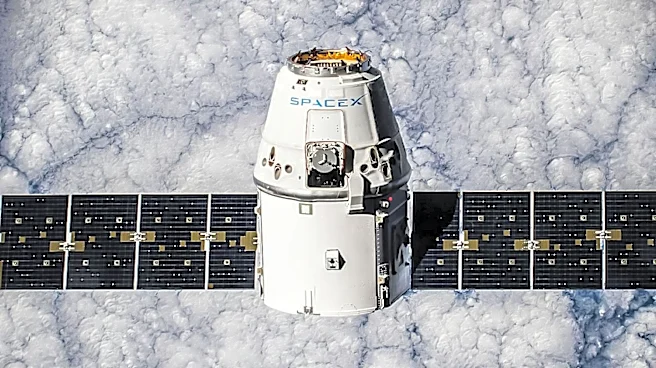
bids across 72 rounds. Verizon secured licenses in 82 markets, including major cities like New York and Chicago, with a gross payment of $3.16 billion. T-Mobile won bids in 102 markets for $277.78 million, focusing on rural midband coverage. AT&T selectively acquired licenses in ten markets for $120.77 million. SpaceX, with winning bids in two markets, including the Gulf of Mexico and Cincinnati, paid $8.49 million. This move aligns with SpaceX's interest in expanding into the terrestrial wireless market, potentially competing with established telecom giants.
Why It's Important?
The AWS-3 spectrum auction results highlight a significant shift in the U.S. telecommunications landscape. SpaceX's participation suggests its ambition to expand beyond satellite services into terrestrial wireless, potentially disrupting the market dominated by Verizon, AT&T, and T-Mobile. This could lead to increased competition, innovation, and possibly lower consumer prices. For the telecom giants, the spectrum acquisition supports their strategic expansion and service enhancement, particularly in underserved rural areas. The auction's outcome also reflects the growing importance of spectrum assets in enabling advanced wireless services, including 5G, which are crucial for economic growth and technological advancement.
What's Next?
SpaceX's acquisition of AWS-3 spectrum could be a precursor to more aggressive bids in future auctions, such as the upcoming upper C-band auction scheduled by the FCC for July 2027. This move may lead to SpaceX developing a retail Starlink product for terrestrial networks, intensifying competition with traditional telecom providers. The telecom companies will likely focus on integrating their new spectrum assets to enhance network capabilities and coverage. The FCC's auction strategy and future spectrum availability will play a critical role in shaping the competitive dynamics of the U.S. wireless market.