






What's Happening?
Zipline, a drone delivery company, is seeking approval from the Federal Aviation Administration (FAA) to significantly expand its operations into the Phoenix and Tucson metropolitan areas of Arizona. The company's proposal outlines a capacity for up to 130,000
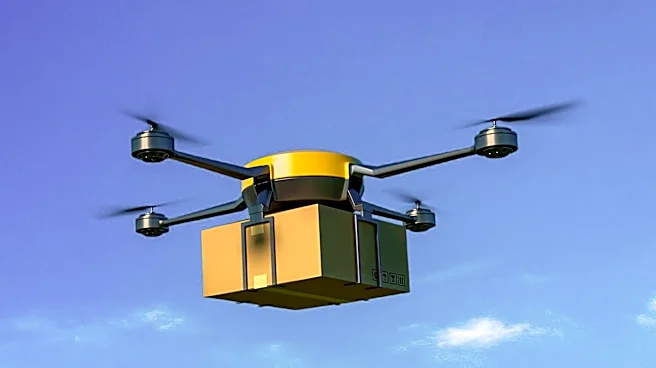
package deliveries per day across both metro areas, with 65,000 deliveries planned for each. This expansion would involve establishing as many as 65 charging stations, or 'Chargers,' and 1,300 package pickup locations, known as 'Dropboxes,' in each area. Zipline intends to use its Platform 2 aircraft, an electrically powered, highly automated vertical takeoff and landing drone capable of carrying an eight-pound payload. These aircraft would generally operate at approximately 330 feet above ground level and cruise at about 70 mph. The proposed service would run seven days a week, including holidays, with 24-hour availability, though 95% of flights are expected between 7 a.m. and 10 p.m. The FAA has released a draft environmental assessment for public review, which includes an analysis of potential noise, wildlife, and other environmental impacts, concluding that noise levels would remain below significance thresholds if setback distances are met. A 30-day public comment period, which began on November 6, 2026, is open until December 7, 2026.
Why It's Important?
This proposed expansion by Zipline represents a significant step forward in the commercialization and widespread adoption of drone delivery services in the United States. If approved, the sheer scale of 130,000 daily deliveries would dramatically increase the accessibility and commonality of drone logistics for consumers in Arizona. This move could set a precedent for similar large-scale drone operations in other major U.S. cities, potentially transforming last-mile delivery services and consumer expectations for speed and convenience. The FAA's environmental assessment and subsequent decision will be crucial in shaping regulatory frameworks for drone operations, particularly concerning noise pollution and environmental impact in densely populated areas. Success in Arizona could also spur further investment and innovation in drone technology, pushing competitors to scale their own operations. For residents, it promises faster delivery times for a wider range of goods, while for traditional logistics companies, it signals a growing competitive threat and a need to adapt to evolving delivery methods.
What's Next?
The immediate next step involves the FAA's review of public comments submitted by the December 7, 2026 deadline. Following this, the agency will complete its environmental review and make a decision on whether to approve Zipline's requested operational changes. If approved, Zipline will proceed with establishing its infrastructure, including charging stations and pickup locations, across the Phoenix and Tucson metropolitan areas. The company will then begin implementing its large-scale drone delivery services. The outcome of this approval process could influence future regulatory decisions for other drone delivery companies seeking to expand their operations across the U.S. Additionally, the success and public reception of Zipline's operations in Arizona will likely be closely watched by other states and municipalities considering similar drone delivery initiatives, potentially leading to a broader rollout of such services nationwide.
Beyond the Headlines
The potential for 130,000 daily drone deliveries in Arizona raises broader questions about urban planning, airspace management, and societal integration of autonomous systems. The sheer volume of proposed flights—up to 390,000 aircraft transits per day across both metropolitan areas—highlights the need for robust air traffic management systems for low-altitude airspace, which is currently less regulated than higher altitudes. This expansion could also accelerate discussions around the 'right to quiet enjoyment' of residential areas versus the convenience of drone delivery, especially concerning potential noise impacts, even if deemed below significance thresholds. Furthermore, the proliferation of delivery drones could reshape urban landscapes, with the need for numerous charging stations and pickup locations potentially influencing commercial and residential development. The ethical implications of constant drone presence, including privacy concerns related to aerial surveillance capabilities, even if unintentional, may also become more prominent as these operations scale. This development marks a significant step towards a future where autonomous aerial vehicles are a common part of daily life, necessitating comprehensive policy and societal adaptation.