
What's Happening?
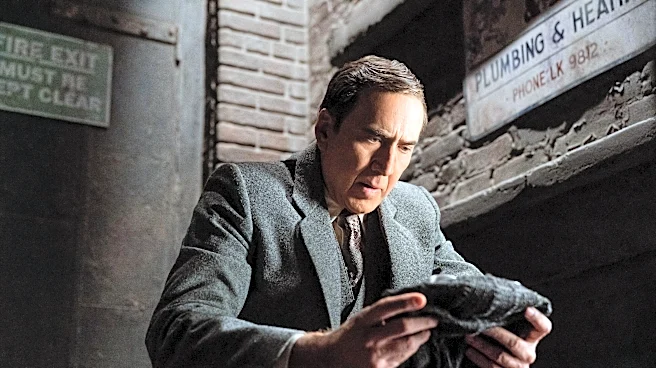
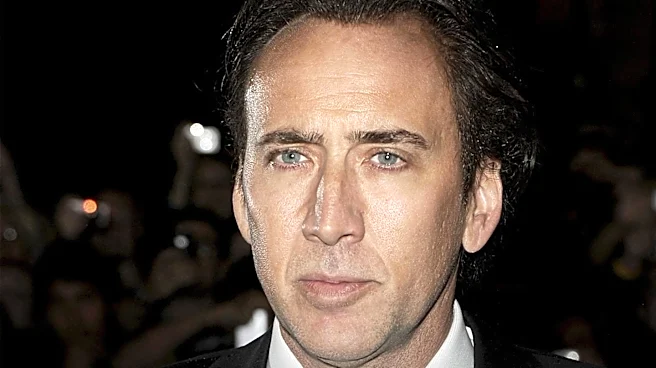
Nicolas Cage, the star of Prime Video's 'Spider-Noir,' has expressed relief following the cancellation of the series after its first season. In an interview with IGN, Cage stated that he felt there was
no more plot to explore for the private investigator character, Ben Reilly, and that the first season was 'perfect.' He emphasized his desire to avoid repeating characters and wearing out his welcome, noting the high-risk nature of the role. Cage also mentioned that the cancellation allowed him to pursue other projects, such as HBO's 'True Detective,' which is also a single-season commitment. Last month, Cage had publicly criticized Amazon, alleging that the company asked him to sign an AI waiver, and stated his reluctance to work with AI-friendly companies. Despite its cancellation, 'Spider-Noir' garnered 2.6 billion viewing minutes in its first six weeks and received 11 Emmy nominations, winning 5.
Why It's Important?
Nicolas Cage's reaction to the cancellation of 'Spider-Noir' highlights several significant trends within the entertainment industry. His desire to avoid character repetition reflects a growing artistic preference among established actors for diverse roles and limited series formats, which offer creative freedom without long-term commitments. This sentiment could influence future production strategies, with more emphasis on self-contained stories rather than multi-season franchises. Furthermore, Cage's previous public stance against Amazon's alleged AI waiver underscores the ongoing tension between creative talent and technological advancements in Hollywood. This issue is a critical point of contention in labor negotiations and intellectual property rights, as actors and creators seek to protect their likeness and work from unauthorized AI replication. The commercial success and critical acclaim of 'Spider-Noir,' despite its short run, also demonstrate that quality content can resonate with audiences even without extended seasons, potentially shifting industry metrics for success beyond sheer longevity. This situation reflects a broader conversation about artistic integrity, technological ethics, and evolving production models in the streaming era.
What's Next?
Following the cancellation of 'Spider-Noir,' Nicolas Cage will continue his career with upcoming roles in HBO's 'True Detective' and the biopic 'Madden,' indicating a strategic shift towards diverse, potentially one-off projects. This move could inspire other actors to prioritize artistic variety over long-term franchise commitments. The broader implications for Prime Video and other streaming platforms include a re-evaluation of their content strategies, particularly regarding the balance between audience demand for popular characters and creators' desires for finite storytelling. The ongoing debate surrounding AI waivers, as highlighted by Cage, is likely to intensify. This issue will remain a critical point in future negotiations between studios and talent, potentially leading to new industry standards or contractual clauses regarding AI usage. For fans of 'Spider-Noir,' the series will remain a critically acclaimed, albeit short-lived, entry in the superhero genre. The industry will watch to see if Cage's outspoken stance on AI influences other prominent figures and if it leads to more widespread resistance against AI integration in creative processes.
Beyond the Headlines
Nicolas Cage's candid remarks about 'Spider-Noir' cancellation and his stance on AI waivers reveal deeper ethical and artistic currents within the entertainment industry. His preference for avoiding character repetition speaks to a broader artistic integrity, where actors prioritize creative challenge and novelty over the financial security of long-running roles. This perspective challenges the prevailing franchise-driven model of Hollywood, suggesting a potential shift towards more auteur-driven or limited series projects that allow for greater artistic exploration. The controversy surrounding AI waivers touches upon fundamental questions of human creativity, intellectual property, and the future of labor in the arts. As AI technology advances, the industry grapples with how to compensate and protect human artists whose work might be replicated or generated by algorithms. Cage's refusal to sign such a waiver highlights a growing resistance movement among creatives who fear the devaluation of their unique contributions and the potential for their likenesses to be exploited without consent. This ethical dilemma extends beyond individual contracts, raising societal questions about the role of technology in art and the preservation of human agency in creative fields. The 'Spider-Noir' situation, therefore, serves as a microcosm of these larger industry-wide transformations and ethical debates.