


What's Happening?
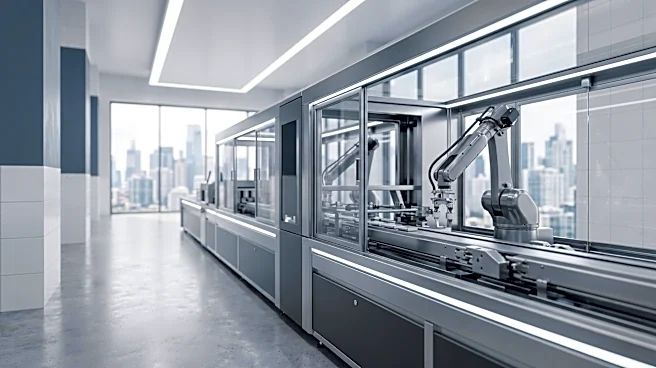
Wonder, a food delivery and dining company, has installed its first Infinite Makeline, an automated bowl assembly system, at its Midtown East location in Manhattan. This new technology aims to streamline the food preparation process, enhancing efficiency
and consistency in meal creation. The company plans to roll out this automated system to dozens of additional locations across the Northeast, Texas, and the Washington, D.C., metropolitan region in 2027. This deployment signifies Wonder's strategic move towards integrating advanced automation into its operational model to support its expansion and improve customer service. The Infinite Makeline represents a significant technological upgrade in the company's efforts to optimize its food service delivery and in-store experience.
Why It's Important?
The deployment of Wonder's Infinite Makeline is important as it reflects a growing trend of automation in the U.S. food service industry. This move could significantly impact operational efficiency, labor costs, and the speed of service for food preparation and delivery companies. By automating bowl assembly, Wonder aims to reduce human error, ensure consistent quality, and potentially lower the need for extensive manual labor, which could lead to cost savings and improved profit margins. For consumers, this could translate to faster order fulfillment and a more standardized product. The expansion of this technology across major U.S. regions like the Northeast, Texas, and Washington, D.C., indicates a broader shift in how food service businesses are approaching scalability and customer experience, potentially setting a precedent for other companies in the competitive food delivery market. This also highlights the increasing role of technology in addressing challenges such as labor shortages and demand for quick service.
What's Next?
Following the initial installation in Manhattan, Wonder's next step is the planned rollout of the Infinite Makeline to tens of locations across the Northeast, Texas, and the Washington, D.C., metro region in 2027. This expansion will be crucial for evaluating the system's performance and scalability in diverse operational environments. The company will likely monitor key metrics such as order accuracy, preparation time, customer satisfaction, and cost efficiencies to refine the technology and its implementation strategy. Success in these regions could pave the way for further national expansion, potentially influencing other food service providers to explore similar automation solutions. Additionally, the adoption of such advanced systems may lead to changes in staffing models, with a potential shift from manual assembly roles to positions focused on technology oversight and maintenance. The broader industry will be watching to see if this automation trend becomes a standard for quick-service and delivery-focused restaurants.
Beyond the Headlines
The introduction of automated systems like the Infinite Makeline by Wonder has deeper implications for the future of work and the consumer experience in the food industry. Ethically, it raises questions about job displacement and the need for workforce retraining as automation becomes more prevalent. Companies adopting such technologies will face the challenge of balancing efficiency gains with social responsibility. Culturally, the increasing automation of food preparation could alter the traditional dining experience, potentially leading to a more standardized, less personalized interaction. However, it could also free up human staff to focus on more complex tasks or customer engagement, enhancing overall service quality in different ways. Legally, the deployment of advanced robotics in food service may necessitate new regulations concerning safety, hygiene, and data privacy. This trend signifies a broader societal shift towards integrating artificial intelligence and robotics into everyday services, pushing the boundaries of how businesses operate and how consumers interact with them.