




What's Happening?
The Indian Ministry of Power has put forth a proposal to broaden the domestic content requirements (DCR) for battery energy storage systems (BESS) across a wider range of solar, wind, and standalone storage projects. This initiative aims to mandate that
BESS used in these projects meet specific DCR standards, extending beyond those currently covered by government incentive schemes. The draft notification suggests changes to bidding rules for various renewable energy projects, including solar, wind-solar hybrid, and standalone battery storage. While the exact DCR percentage and specific battery components for local manufacturing are yet to be detailed, the government plans to issue subsequent guidelines. This move signifies a potential expansion of India's domestic manufacturing push in battery storage, which has previously been linked to particular government-supported programs. Separately, the Union Cabinet approved a minimum 40% DCR for BESS projects under a new ₹14,500-crore Viability Gap Funding (VGF) scheme, designed to support 30 GWh of battery storage capacity as part of a larger 92 GWh grid-scale storage program. The ministry is inviting comments on these proposed amendments until November 25.
Why It's Important?
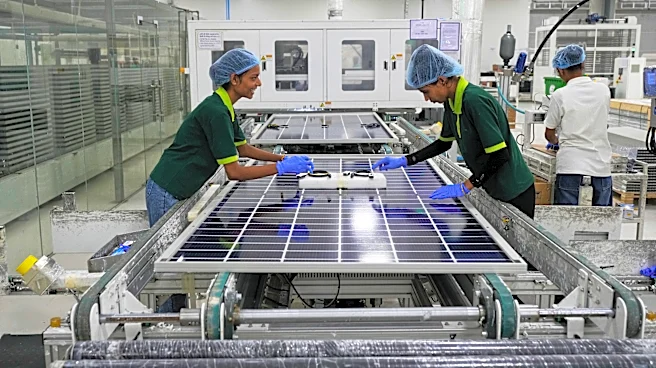
This policy shift by the Indian government holds significant implications for the global renewable energy supply chain and domestic manufacturing. By expanding DCR for BESS, India aims to reduce its reliance on imported components, fostering local industry growth and job creation within the country. This could lead to increased investment in domestic battery manufacturing facilities and related technologies, potentially making India a more self-sufficient player in the renewable energy sector. For international manufacturers, this could necessitate establishing production facilities in India or partnering with local companies to comply with the DCR, impacting their market access and operational strategies. The emphasis on local content could also drive down the cost of BESS over time through economies of scale and localized innovation. However, it might also initially lead to higher costs or slower project deployment if the domestic supply chain is not yet fully mature or competitive. The move aligns with broader national goals of energy security and economic development, positioning India as a leader in renewable energy manufacturing.
What's Next?
The immediate next step involves the public consultation period for the proposed amendments, which concludes on November 25. Following this, the Ministry of Power will likely review the feedback and finalize the new bidding rules and DCR guidelines. The government is expected to issue detailed specifications regarding the DCR percentage and the specific battery components that must be manufactured domestically. Project developers and BESS manufacturers will then need to adapt their strategies to comply with these new regulations. This could involve re-evaluating supply chains, investing in local manufacturing capabilities, or forming new partnerships. The implementation of these expanded DCRs will be crucial for the success of India's ambitious renewable energy targets, particularly its 92 GWh grid-scale storage program. The long-term impact will depend on the effectiveness of these policies in stimulating domestic production while maintaining cost-competitiveness and technological advancement.
Beyond the Headlines
The push for domestic content in battery energy storage systems in India reflects a growing global trend among nations to localize critical components of their clean energy transitions. This strategy goes beyond mere economic protectionism; it's about building national resilience, securing supply chains against geopolitical disruptions, and capturing the economic benefits of the green industrial revolution. The ethical implications revolve around ensuring fair competition and avoiding potential trade disputes if DCRs are perceived as overly restrictive. Culturally, it reinforces a narrative of self-reliance and national technological prowess. Legally, the implementation of these DCRs will need to navigate international trade agreements and intellectual property rights. In the long term, this could lead to a more fragmented global renewable energy market, with regional manufacturing hubs emerging, potentially altering the dynamics of international trade and technological collaboration in the clean energy sector.