






What's Happening?
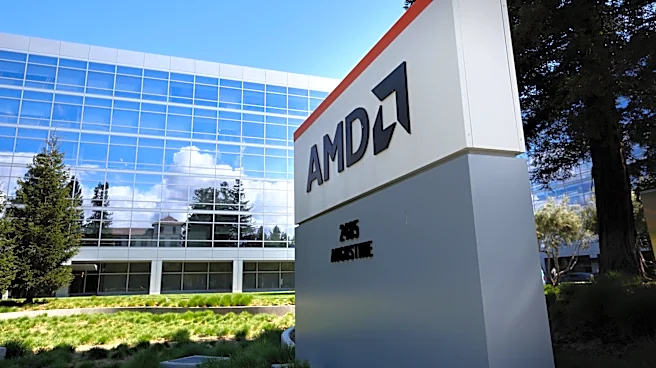
Advanced Micro Devices (AMD) experienced a significant drop in its share price on November 19, 2026, closing down 7.72% at $489.19. This decline followed the publication of an investigative report by Hunterbrook Media. The report alleged that IEIT Systems,
a Chinese server maker blacklisted by the U.S. Commerce Department in March 2025, continued to receive newer AMD firmware. Hunterbrook Media claimed that IEIT had incorporated at least six newer versions of AMD's firmware into its products since being added to the Entity List, with the most recent update posted on October 19. Hunterbrook Capital, an affiliate, disclosed it held a short position in AMD. In response, an AMD spokesperson stated that the claims misrepresent the company's business practices and relationships, affirming AMD's compliance with U.S. export control laws and regulations. CNBC reported that it did not independently verify Hunterbrook's information.
Why It's Important?
This development is significant for the U.S. technology sector and its adherence to export control regulations. Allegations of a U.S. chipmaker supplying technology to a blacklisted Chinese entity raise concerns about national security and the effectiveness of trade restrictions. If proven, such actions could lead to severe penalties for AMD and potentially trigger broader scrutiny of supply chain compliance within the semiconductor industry. The incident also highlights the ongoing tension between U.S. efforts to restrict technology transfer to certain Chinese companies and the globalized nature of the tech supply chain. For investors, the report introduced uncertainty, leading to a substantial market capitalization loss for AMD and potentially impacting investor confidence in companies with significant exposure to the Chinese market.
What's Next?
The immediate next steps will likely involve further scrutiny of Hunterbrook's allegations and AMD's internal compliance procedures. Regulatory bodies, particularly the U.S. Commerce Department, may launch investigations to determine if any violations of export control laws occurred. AMD will likely need to provide more detailed explanations and evidence of its compliance to reassure investors and regulators. The situation could also prompt other U.S. technology companies to review their own relationships and supply chains with entities in China, especially those on U.S. blacklists. The upcoming expiration of a rule extending restrictions to foreign companies at least 50% owned by blacklisted entities on January 10, 2027, and a new interim final rule requiring licenses for advanced chips shipped to Singapore and other countries, could further complicate the landscape for chipmakers.
Beyond the Headlines
Beyond the immediate financial and regulatory implications, this situation underscores the complex geopolitical landscape influencing the technology industry. The U.S. government's increasing use of export controls as a tool of foreign policy creates a challenging environment for multinational corporations. Companies like AMD must navigate a delicate balance between maintaining access to lucrative markets like China and adhering to stringent U.S. regulations. This incident could also fuel debates about the transparency and enforceability of export controls, as well as the role of investigative short sellers in uncovering potential corporate malfeasance. The long-term implications could include a re-evaluation of global supply chain strategies by U.S. tech firms, potentially leading to further decoupling or diversification away from certain markets.