







What's Happening?
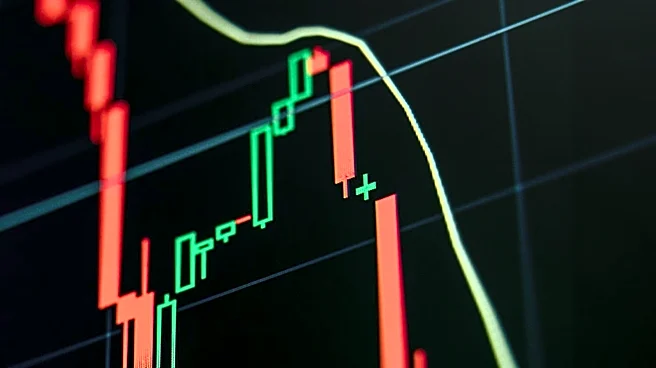
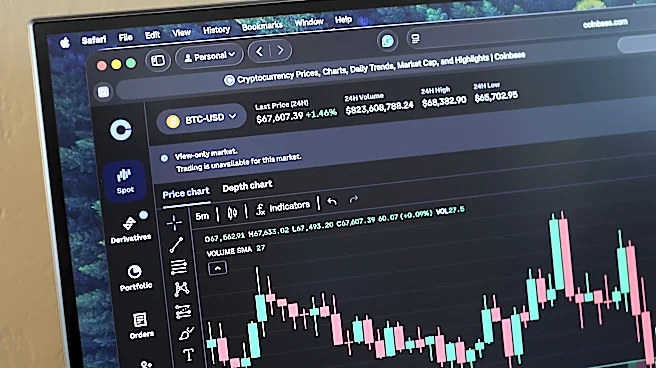
The cryptocurrency market is currently experiencing a period of widespread weakness, with selling pressure dominating price action across major digital assets. Bitcoin, the market's benchmark, is struggling to maintain stability, trading near the $75,000
area after failing to sustain a recovery above $80,000. Ripple has emerged as one of the weakest cryptocurrencies of the week, breaking its recent range-bound structure and falling below its 200-period simple moving average, indicating a new bearish trend. Ripple is down approximately 5.3% on the week. Cardano is noted as one of the worst-performing assets year-to-date, with a decline of roughly 43.84%. Even Ether, while showing some resistance, has posted a decline of around 0.63%. This overall market sentiment reflects limited confidence and a lack of consistent demand, with most major cryptocurrencies trading below their levels from the beginning of 2026.
Why It's Important?
The sustained weakness in the cryptocurrency market carries significant implications for investors, financial institutions, and the broader digital asset ecosystem in the U.S. The struggle of Bitcoin, often seen as a bellwether, to maintain stability can erode investor confidence, potentially leading to further capital outflows from the crypto space. For U.S. investors, this means a decline in the value of their digital asset portfolios, impacting individual wealth and potentially affecting investment strategies. Financial institutions that have increased their exposure to cryptocurrencies may face increased volatility and risk. The underperformance of major altcoins like Ripple and Cardano highlights a lack of diversification benefits within the current bearish trend, suggesting that even established projects are vulnerable. This market downturn could also influence regulatory discussions in the U.S., as policymakers might view increased volatility as a reason for stricter oversight, potentially impacting innovation and adoption within the country.
What's Next?
The immediate future for the cryptocurrency market appears to be characterized by continued selling pressure unless a significant catalyst emerges to restore investor confidence. Analysts will be closely watching Bitcoin's price action, particularly its ability to hold key support levels around $73,400, which coincides with its 200-period simple moving average. A sustained break below this level could signal a more structured bearish phase. For Ripple, the consolidation of its bearish trend suggests further downside potential if selling pressure persists. The market's high correlation with Bitcoin means that any recovery in BTC would likely be necessary to lift other cryptocurrencies. Stakeholders, including institutional investors and retail traders, will be monitoring macroeconomic indicators, regulatory developments, and any major news from key projects for signs of a potential turnaround. Without renewed buying momentum, the current phase of weakness is expected to continue shaping market dynamics in the coming weeks.
Beyond the Headlines
The current cryptocurrency market downturn extends beyond mere price fluctuations, touching upon deeper structural and psychological aspects of the digital asset space. The inability of Bitcoin to sustain bullish momentum, despite its increasing institutional adoption, suggests that broader market sentiment is still heavily influenced by risk aversion and macroeconomic uncertainties. The underperformance of established altcoins like Ripple and Cardano, even after significant development and ecosystem growth, raises questions about the long-term value proposition of these assets in a bear market. This period of weakness could serve as a crucial test for the resilience of various blockchain projects and their underlying technologies. Furthermore, the prolonged slump might lead to a 'flight to quality' within the crypto space, where investors consolidate their holdings into more established assets, potentially leading to further divergence between top-tier and lower-tier cryptocurrencies. This environment also provides an opportunity for regulatory bodies in the U.S. to refine their approaches, potentially leading to more robust frameworks that could either stabilize or further challenge the market's growth.