



What's Happening?
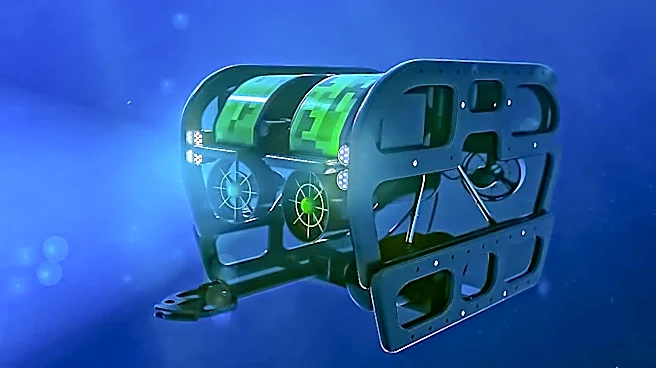
Zupt is deploying its 3D Recon V2 subsea imaging system for an inspection campaign in the U.S. Gulf. This technology is designed to generate high-resolution 3D models to support subsea asset integrity assessments. The deployment follows successful system integration
testing, which included trajectory evaluations, data volume and operational time estimates, and task planning for the structures to be inspected. The 3D Recon V2 system, rated for water depths up to 4,000 meters, combines two high-resolution machine-vision cameras with a MEMS inertial measurement unit (IMU). This integration allows the system to produce geospatially accurate 3D models of subsea assets, providing detailed digital records for integrity management and inspection, repair, and maintenance (IRM) applications.
Why It's Important?
The deployment of Zupt's 3D Recon V2 system is crucial for enhancing the safety and operational efficiency of subsea infrastructure in the U.S. Gulf. By providing highly accurate 3D models, the technology enables engineers to thoroughly evaluate asset conditions, identify potential issues, and plan necessary repairs or maintenance with greater precision. This proactive approach to integrity management can prevent costly failures, reduce environmental risks, and extend the lifespan of critical subsea equipment. The ability to generate real-time sparse point clouds for navigation and quality control further streamlines operations, making subsea inspections more efficient and reliable. This advancement is particularly important in the deepwater environments of the U.S. Gulf, where traditional inspection methods can be challenging and expensive.
What's Next?
Beyond integrity management and IRM, Zupt indicates that the 3D Recon V2 technology has broader applications. These include jumper and spool metrology, mooring chain inspection, hull inspection, pipeline out-of-straightness surveys, and pre-installation and as-built documentation. The successful implementation of this technology in the U.S. Gulf campaign could lead to its wider adoption across the offshore energy industry, both domestically and internationally. As the demand for reliable and efficient subsea asset management grows, Zupt's system could become a standard tool for operators seeking to optimize their inspection and maintenance strategies. Future developments may focus on integrating AI and machine learning with the 3D models to predict potential failures and automate inspection analysis.
Beyond the Headlines
The use of advanced 3D subsea inspection technology like Zupt's 3D Recon V2 signifies a broader trend towards digitalization and automation in the offshore energy sector. This shift is driven by the need to improve safety, reduce operational costs, and enhance environmental protection in increasingly complex and remote subsea environments. The technology's capability to create detailed digital twins of physical assets opens up possibilities for advanced analytics, predictive maintenance, and remote monitoring, transforming how subsea infrastructure is managed throughout its lifecycle. This innovation also contributes to the overall resilience of energy supply chains by ensuring the integrity of critical underwater assets, which are vital for energy security and economic stability.