








What's Happening?
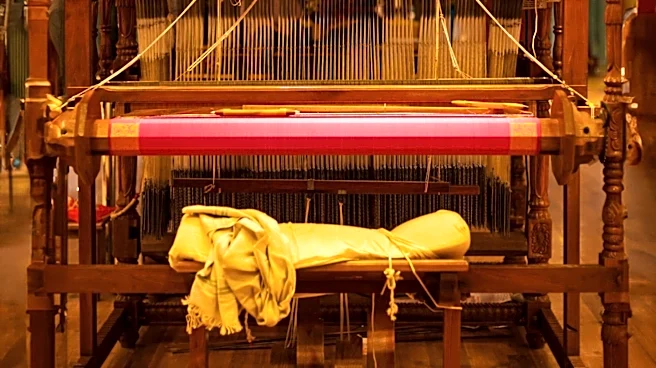
Diné artist and weaver Marilou Schultz is currently featured in an exhibition titled “Replica of a Chip: The Weaving Technology of Marilou Schultz” at the Hessel Museum of Art in Annandale-on-Hudson, New York, running through November 29. Schultz, who
grew up in a family of weavers, discusses how her practice is shaped by tradition, mathematics, technology, and experimentation. She learned weaving from her mother and grandmother and has expanded the possibilities of the art form through her computer-chip tapestries and three-dimensional works. The exhibition highlights her unique approach to weaving, which blends ancestral knowledge with contemporary innovation. Schultz also acknowledges the influence of other fiber artists like Jane Hays and Anni Albers, as well as the exhibition “Woven by the Grandmothers,” on her artistic journey.
Why It's Important?
Marilou Schultz's exhibition is significant for its contribution to the understanding and evolution of Diné weaving, a culturally rich art form. By integrating modern technology and mathematical concepts into traditional weaving techniques, Schultz demonstrates how ancient practices can remain relevant and dynamic in the contemporary art world. This approach not only preserves cultural heritage but also pushes artistic boundaries, offering new perspectives on textile art. The exhibition at the Hessel Museum of Art provides a platform for broader recognition of Indigenous artists and their innovative contributions, fostering a deeper appreciation for the intersection of art, culture, and technology. It also highlights the importance of intergenerational knowledge transfer in maintaining and evolving artistic traditions.
What's Next?
The exhibition “Replica of a Chip: The Weaving Technology of Marilou Schultz” will conclude on November 29 at the Hessel Museum of Art. Following the exhibition, Schultz's work is likely to continue influencing contemporary weaving and Indigenous art discussions. Her innovative blend of tradition and technology may inspire other artists to explore similar avenues, further expanding the scope of textile arts. Educational institutions and cultural organizations may also draw upon her work to illustrate the dynamic nature of cultural heritage and the role of artists in its evolution. Continued engagement with her art could lead to further exhibitions, academic studies, and public programs that delve into the themes she explores.
Beyond the Headlines
Marilou Schultz's work transcends mere artistic expression; it embodies a profound dialogue between cultural heritage and technological advancement. Her computer-chip tapestries, for instance, symbolize the intricate connection between the digital age and ancestral knowledge systems, suggesting that technology can be a tool for cultural preservation rather than solely a force for modernization. This raises ethical considerations about intellectual property and cultural appropriation in the context of traditional arts. Furthermore, her exploration of mathematics within weaving highlights the inherent scientific principles embedded in traditional crafts, challenging conventional distinctions between art and science. Her practice serves as a powerful statement on the resilience and adaptability of Indigenous cultures in a rapidly changing world, offering a model for how communities can honor their past while embracing the future.