


What's Happening?
The visual effects (VFX) team behind Netflix's 'Stranger Things' faced significant challenges in creating the final season, which the Duffer brothers envisioned as a 'mega movie.' VFX supervisor Betsy Paterson noted that the final season required a substantially
higher number of shots than a typical two-hour feature film, leading to an expanded budget. The team prioritized practical effects to ensure sets felt tactile, allowing actors to interact with physical elements before digital enhancements. This approach was crucial for maintaining the show's grounded perspective, even amidst its otherworldly dimensions. Examples include building a section of the interdimensional 'membrane wall' for characters to climb and using real goo for the liquefying room scene. A major undertaking was designing the new alternate world, the Abyss (Dimension X), from scratch, as it lacked the established visual history of the Upside Down. The team considered filming in a real desert but ultimately relied on extensive scanning and reference photos to create a realistic CG environment.
Why It's Important?
The extensive use of both practical and advanced digital effects in 'Stranger Things' highlights a significant trend in high-budget television production, blurring the lines between film and TV in terms of visual spectacle and technical ambition. This commitment to visual fidelity sets a new benchmark for streaming series, influencing audience expectations for immersive storytelling. The challenges faced by the VFX team, particularly in creating new worlds and evolving character designs like Vecna's, demonstrate the increasing complexity and resource demands of modern visual effects. This push for cinematic quality in television impacts the entertainment industry by driving innovation in VFX technologies and demanding larger production budgets, potentially leading to more visually ambitious projects across the board. It also underscores the critical role of VFX artists in shaping narrative and character development, as their work directly contributes to how audiences perceive and engage with fantastical elements.
What's Next?
The detailed insights into the VFX process for 'Stranger Things' season five suggest a continued evolution in how visual effects are integrated into storytelling, particularly in the streaming landscape. Future productions are likely to adopt similar hybrid approaches, combining practical effects with sophisticated digital enhancements to achieve greater realism and immersion. The emphasis on creating tactile environments for actors to interact with could become a more prevalent practice, enhancing performance authenticity. The industry may also see further investment in advanced digital character design and world-building, pushing the boundaries of what is possible on screen. As 'Stranger Things' concludes, its legacy in visual effects will likely influence how other major franchises approach their final seasons, aiming for equally epic and visually stunning conclusions that resonate with audiences and critics alike.
Beyond the Headlines
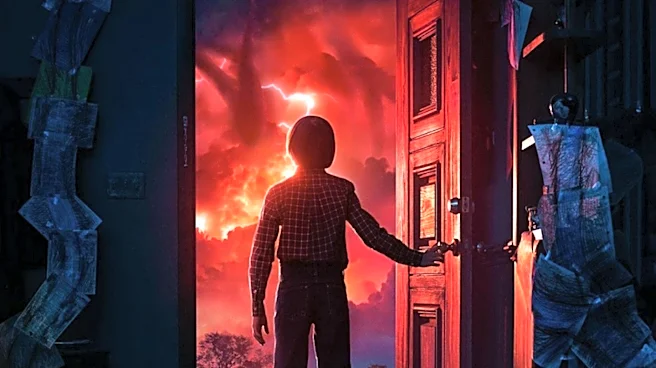
The meticulous effort to recreate a young Will Byers for the opening sequence, using every available piece of footage and even a stand-in actor, reveals a deeper implication of modern VFX: the ability to manipulate and even 'de-age' actors with remarkable precision. This capability raises ethical and creative questions about the future of acting, character continuity, and the preservation of an actor's original performance. While used here for narrative consistency, the technology's potential for broader application in film and television could lead to discussions about digital immortality for actors, the creation of entirely synthetic performances, or the re-casting of roles without new actors. Furthermore, the show's ability to make fantastical elements feel 'real' through a blend of practical and digital effects speaks to the evolving relationship between technology and artistic expression, challenging traditional notions of filmmaking and expanding the creative toolkit available to storytellers.