



What's Happening?
D-Wave Quantum Inc. has initiated a beta program for its gate-model quantum computing simulator. This launch marks a significant step in the company's development of gate-model quantum technology. The simulator provides select commercial and research
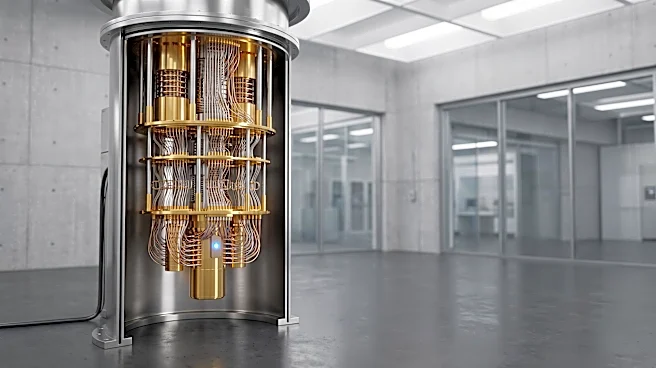
organizations, including BBVA, FirstQFM, Florida Atlantic University, and the Jülich Supercomputing Centre, early access to experiment with error-aware programming. This technology is designed to facilitate efficient quantum error correction with reduced hardware overhead as systems scale. The simulator is built upon D-Wave’s dual-rail superconducting gate-model technology, which was recently validated in peer-reviewed research published in Nature for its fast, high-fidelity two-qubit entangling gate that maintains error-detection advantages. Access to the simulator is provided through D-Wave’s Leap quantum cloud service and Ocean SDK, with flexible development bundles also planned to offer expert guidance.
Why It's Important?
This beta program is crucial for advancing the practical application of quantum computing, particularly in the U.S. and globally. By enabling early access to error-aware programming, D-Wave is addressing a fundamental challenge in quantum computing: error correction. Efficient error correction is vital for developing commercially viable gate-model quantum computers, which have the potential to solve complex computational problems beyond the capabilities of classical supercomputers. Organizations like BBVA are exploring its use for financial services applications such as portfolio optimization, fraud detection, and derivatives valuation, indicating a potential transformation in these sectors. The involvement of U.S. institutions like Florida Atlantic University also highlights the program's role in preparing the next generation of the quantum workforce and fostering research into robust quantum machine learning models, which could have significant long-term impacts on various industries.
What's Next?
Following the beta program, D-Wave plans to make the gate-model simulator generally available. The insights and feedback gathered from the current participants will be instrumental in refining the simulator and preparing for the deployment of D-Wave's forthcoming gate-model systems. The company also intends to offer flexible development bundles that combine simulator access with future gate-model systems and expert guidance, aiming to streamline onboarding and support ongoing research and development. This phased approach suggests a continuous evolution of D-Wave's quantum computing offerings, with a focus on integrating error-aware programming into future physical hardware. The ongoing research by participants like FirstQFM into using detected errors and real-time control to improve quantum computations will likely inform future advancements in fault-tolerant quantum computing.
Beyond the Headlines
The launch of D-Wave's gate-model simulator beta program signifies a broader shift in the quantum computing landscape towards practical, fault-tolerant systems. Beyond immediate applications, this initiative underscores the growing importance of hybrid computing approaches, where quantum processing units (QPUs) are integrated with classical CPUs and GPUs. This integration is seen as key to unlocking greater value from classical AI and tackling complex problems in chemistry, materials science, and optimization that are currently beyond classical computing's reach. The emphasis on error-aware programming and efficient quantum error correction highlights the industry's move from theoretical possibilities to tangible, reliable quantum solutions. This development could accelerate the transition of quantum computing from a research-intensive field to one with widespread commercial and governmental applications, potentially reshaping industries and national security capabilities.