



What's Happening?
Oklo Inc., a nuclear energy company focused on generating power and recycling waste, is experiencing significant financial pressures despite holding over $3.1 billion in cash, cash equivalents, and marketable securities as of September. The company's
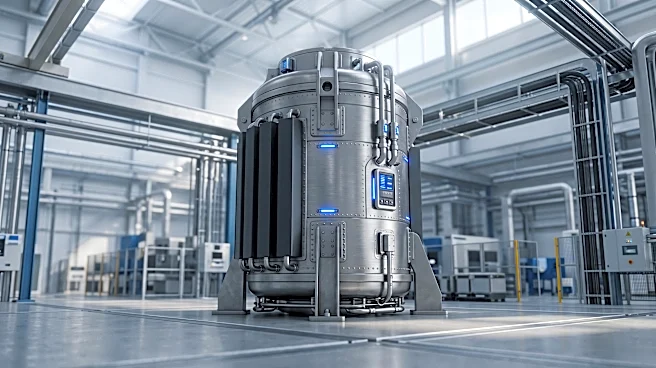
stock has plummeted by 73.2% year-to-date. Oklo's business model involves financing and owning its nuclear facilities, aiming to generate revenue by selling electricity once plants are operational. Currently, Oklo is undertaking structural work on its first Aurora plant in Idaho, having received U.S. Department of Energy approval for its preliminary safety analysis. This allows for safety-related construction to proceed, though final safety reviews and operational permits are still pending. The company also has plans for a 1.2-gigawatt campus in Ohio, supported by an agreement with Meta, and has secured a fuel supply with Centrus. Additionally, the Energy Department has cleared its Groves-1 test reactor for research and demonstration, which will aid in operator training and medical isotope business development. Despite these advancements, Oklo's operational cash burn, excluding construction spending, was $111 million in the first nine months of 2026, indicating a need for substantial capital to fund its long-term growth strategy.
Why It's Important?
Oklo's financial situation and operational strategy are significant for the U.S. energy sector, particularly in the context of developing advanced nuclear technologies like small modular reactors (SMRs). The company's approach of owning and operating its plants, while potentially offering long-term revenue streams, creates substantial upfront capital demands and near-term cash flow challenges. This model contrasts with peers like NuScale Power, which focuses on selling reactor modules and services. Oklo's ability to successfully navigate regulatory approvals and fund its construction projects will be a critical test for this integrated business model in the nascent SMR market. A successful deployment could demonstrate a viable path for private companies to contribute to grid stability and decarbonization, especially for energy-intensive sectors like data centers. Conversely, prolonged financial strain or delays could deter further investment in similar ventures, impacting the broader adoption of advanced nuclear power in the U.S. The company's stock performance reflects investor skepticism regarding the timeline and capital intensity of its projects, highlighting the risks associated with pioneering new energy infrastructure.
What's Next?
Oklo's immediate next steps involve securing final safety reviews and operational permits for its Aurora plant in Idaho, which will dictate when it can begin selling power. The company also needs to progress through the grid connection process for its Ohio project. Given its capital-intensive business model, Oklo will likely need to continue raising significant capital to fund its construction and operational expenses. While it currently possesses substantial cash reserves, continued share sales to fund growth could dilute existing shareholders' ownership. The market will closely watch for firm orders or power purchase agreements for its future plants, as these milestones are crucial for validating its business model and improving investor confidence. Regulatory decisions from the U.S. Nuclear Regulatory Commission regarding its reactor designs and operational readiness will also be pivotal. The company's ability to manage its cash burn while advancing multiple complex projects will determine its trajectory in the competitive nuclear energy landscape.
Beyond the Headlines
The challenges faced by Oklo Inc. underscore broader implications for the commercialization of advanced nuclear technology in the U.S. The capital-intensive nature of building and owning nuclear power plants, even small modular ones, presents a significant barrier to entry and growth for private companies. This situation highlights the tension between the long-term energy security and climate benefits of nuclear power and the short-to-medium-term financial risks for investors. The success or failure of companies like Oklo could influence future government policies regarding subsidies, loan guarantees, and regulatory streamlining for advanced nuclear projects. Furthermore, the competition between different business models—Oklo's ownership model versus NuScale's vendor model—will provide valuable insights into the most effective pathways for deploying new nuclear capacity. The outcome will also impact the energy supply chain, particularly for data centers and other industries seeking reliable, carbon-free power, potentially shaping the future of industrial energy sourcing in the U.S.