





What's Happening?
Researchers at Washington University in St. Louis, led by Professor Gang Wu, have developed a new approach to improve low-temperature fuel cells, which could potentially power data centers across the United States. The study, published in Nature Nanotechnology,
involves a novel carbon structure that enhances the efficiency and durability of fuel cells by using platinum cobalt intermetallic nanoparticles. This innovation addresses the challenge of using minimal platinum, a precious metal, while maintaining high performance. The new carbon structure allows for the formation of ordered intermetallic structures at higher temperatures without causing the nanoparticles to clump, thus improving both activity and stability. This development could enable data centers to generate electricity directly from hydrogen, reducing their reliance on the national power grid.
Why It's Important?
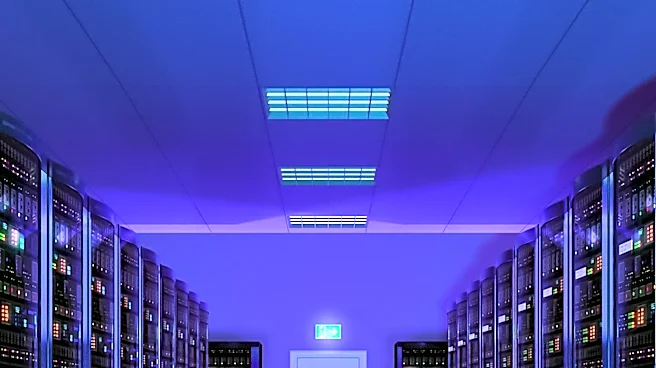
The rapid expansion of data centers in the U.S. is significantly increasing electricity demand, with projections indicating they could account for 9% of the nation's electricity generation by 2030. The new fuel cell technology offers a sustainable solution by potentially allowing data centers to self-generate electricity, thereby alleviating pressure on the electric grid. This advancement not only supports the growing energy needs of data centers but also contributes to reducing carbon emissions by utilizing hydrogen, a clean energy source. The successful implementation of this technology could lead to significant energy savings and environmental benefits, positioning the U.S. as a leader in sustainable data center operations.
What's Next?
Further development and collaboration with industry partners are necessary to address remaining challenges and advance the commercialization of this fuel cell technology. If successful, this could lead to widespread adoption in data centers and other sectors, such as transportation and general electricity generation. The research team has filed a patent for the technology, indicating potential future applications and partnerships. The next steps involve scaling the technology for industrial use and exploring its integration into existing data center infrastructures.