
What's Happening?
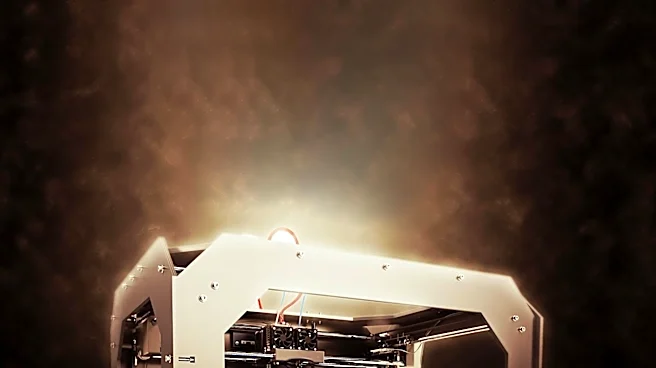
Incus GmbH has introduced the Hammer Pro25, a 3D printer utilizing lithography-based metal manufacturing (LMM) designed for the serial production of small, geometrically complex metal components. This
technology aims to address the growing demand for individualized medical parts, such as orthodontic brackets, which are typically produced by metal injection molding (MIM). The Pro25 boasts a material throughput of up to 980 cm³ per hour, nearly ten times that of its predecessor, the Lab35. It features a large continuous production platform (200 × 204.55 mm) and automated manipulators for feedstock reloading and print-job extraction, allowing for continuous operation. Incus defines 'mass production' in this context as the reliable, repeatable, and economically competitive serial manufacture of parts, rather than a fixed volume threshold, emphasizing the ability to produce individualized parts efficiently.
Why It's Important?
The Hammer Pro25's capabilities are highly significant for the U.S. medical device manufacturing sector, particularly in orthodontics. With millions of patients requiring individualized treatments, the ability to mass-produce patient-specific metal brackets economically can revolutionize the industry. Traditional MIM processes struggle with customization due to high tooling costs, making individualized parts expensive. The Pro25 offers a cost-effective alternative by enabling tool-free production, design freedom, and the ability to manufacture different or individualized parts within the same build. This innovation can lead to more precise and effective orthodontic treatments, improving patient outcomes. Economically, it can reduce manufacturing costs for customized medical devices, potentially making advanced treatments more accessible and fostering growth in the additive manufacturing market within the U.S.
What's Next?
The Hammer Pro25 is poised for integration into existing manufacturing workflows, particularly those familiar with MIM processes, as LMM shares similar post-processing steps like debinding and sintering. Manufacturers will need to develop expertise in LMM-specific aspects such as design for LMM, feedstock handling, and shrinkage compensation. Incus GmbH is supporting this transition with application development, process transfer, and hands-on training. The focus will be on automating the entire production chain for patient-specific parts, from digital design file generation to final inspection and packaging. This will likely lead to increased adoption of LMM technology in the U.S. for various medical and industrial applications requiring high-volume, customized metal components, pushing the boundaries of what is considered mass production in additive manufacturing.
Beyond the Headlines
The development of the Hammer Pro25 highlights a fundamental shift in manufacturing paradigms, moving from mass production of identical items to mass customization. This has profound implications for industries beyond medicine, enabling highly personalized products across various sectors. The technology also raises questions about the future of skilled labor in manufacturing, as automation reduces the need for manual intervention but increases the demand for specialized knowledge in areas like additive manufacturing design and process control. Furthermore, the ability to produce complex, individualized parts on demand could lead to more sustainable manufacturing practices by reducing waste associated with traditional tooling and inventory. This innovation represents a convergence of advanced materials science, digital design, and automated production, signaling a new era for industrial output.