




What's Happening?
New Zealand-based Wētā Workshop employed 3D printing technology to create the intricate wicker costume for actor Alexander Skarsgård in the new movie "Wicker." The film features Olivia Colman as a lonely fisherwoman who commissions a wicker husband, played
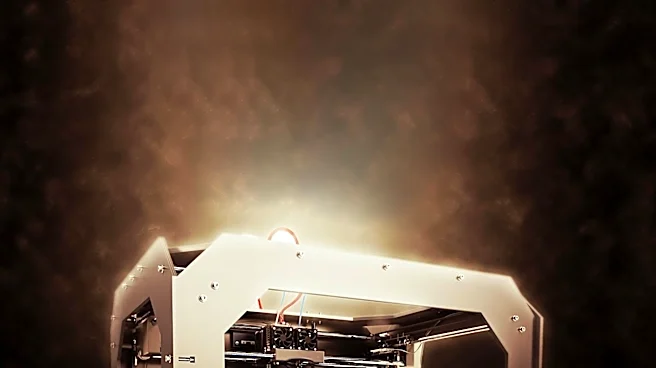
by Skarsgård. The costume, designed to appear as if Skarsgård is covered in wicker, was actually a practical suit with prosthetic makeup. Wētā Workshop began the process with a full-body scan of Skarsgård to sculpt custom pieces. The facial prosthetic consisted of ten 3D-printed components, while the main costume was composed of 50 individual 3D-printed appliances. These pieces were painted to resemble wicker and then stitched onto a semi-flexible spandex suit. Joe Dunckley, the prosthetic makeup designer, explained that a thermoplastic elastomer was used, with a laser fusing the powder to build intricate weaves and complex geometries.
Why It's Important?
The use of advanced 3D printing by Wētā Workshop for a major film like "Wicker" highlights the growing integration of additive manufacturing in the entertainment industry. This technology allows for the creation of highly detailed, complex, and custom-fitted costumes and prosthetics that might be difficult or impossible to achieve with traditional methods. For the U.S. film industry, this signifies a continued push towards innovative production techniques that enhance visual effects and character realism. It also demonstrates the potential for 3D printing to reduce production time and costs for intricate designs, while offering greater creative freedom to designers. The success of such applications could lead to wider adoption of 3D printing in Hollywood, impacting costume design, prop creation, and special effects departments.
What's Next?
The successful application of 3D printing in "Wicker" is likely to encourage further exploration and adoption of this technology in future film productions. As 3D printing capabilities advance, it is expected to become an even more integral tool for creating elaborate costumes, props, and creature effects. This could lead to specialized training programs for costume designers and prop makers in 3D modeling and printing. Furthermore, the availability of free 3D print files for a collectible popcorn bucket modeled after Skarsgård’s "wicker" torso prosthetics, as mentioned in the source, indicates a potential trend for studios to leverage 3D printing for promotional merchandise, creating interactive fan experiences and new revenue streams.
Beyond the Headlines
Beyond its practical applications in film production, the use of 3D printing in "Wicker" touches upon broader themes of technological innovation and artistic expression. It showcases how cutting-edge manufacturing techniques can serve creative visions, pushing the boundaries of what is visually possible on screen. This development also raises questions about the future of traditional craftsmanship in costume and prop design, as digital fabrication becomes more prevalent. The ability to rapidly prototype and produce complex designs could democratize access to high-quality costume elements, potentially benefiting independent filmmakers and smaller production houses. Moreover, the integration of 3D printing in film underscores the interdisciplinary nature of modern filmmaking, blending art, engineering, and digital technology.