







What's Happening?
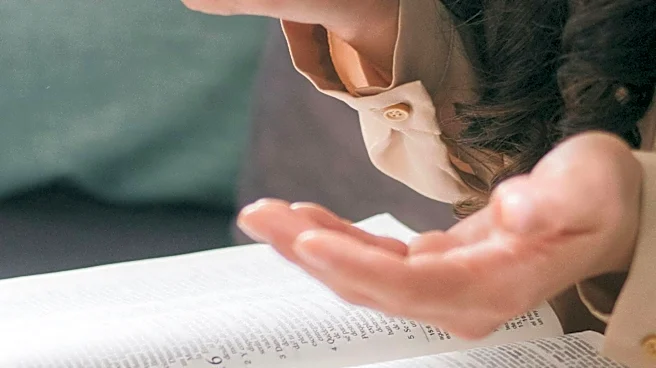
Holly Mackle, a Christian author and school librarian, is advocating for a practice she calls 'reading with the Holy Spirit,' encouraging readers to use discernment guided by their faith when selecting and engaging with books. Mackle's approach suggests
that individuals should heed 'nudges' or 'convictions' that arise while reading, particularly concerning content that might be perceived as leading towards sin, such as graphic sexual descriptions. She emphasizes that while book recommendations and lists are helpful, personal conviction and spiritual guidance should ultimately inform reading choices. This perspective comes amidst broader discussions about book selections in educational and personal contexts, where parents and educators often seek guidance on what to read and what to avoid, especially concerning 'trickier reading topics.'
Why It's Important?
Mackle's advocacy for 'reading with the Holy Spirit' introduces a faith-based dimension to the ongoing debates about book selection and censorship in the U.S. It shifts the focus from external bans or prescribed lists to internal, individual discernment guided by religious conviction. This approach could empower individuals within Christian communities to make personal choices about their reading material, potentially reducing reliance on external authorities or broad censorship efforts. However, it also raises questions about the subjective nature of 'personal conviction' and how it might influence broader community standards or school library policies. The emphasis on individual spiritual guidance could foster a more nuanced discussion about content, moving beyond simple 'good or bad' binaries, but it also risks leading to varied interpretations and potential conflicts over what constitutes appropriate material, especially in shared spaces like school libraries.
What's Next?
This perspective is likely to resonate within Christian educational and parenting circles, potentially influencing how families and faith-based institutions approach literature. It may encourage more discussions within these communities about personal discernment and the role of faith in media consumption. However, it could also contribute to the existing polarization around book content, as different individuals and groups will interpret 'spiritual guidance' differently, leading to varied conclusions about what is acceptable. The concept might be integrated into Christian educational curricula or parenting resources, offering an alternative framework for navigating the complex landscape of modern literature. The broader impact on public school systems or secular institutions is less clear, as their policies are typically guided by principles of intellectual freedom and diverse representation rather than religious discernment.
Beyond the Headlines
The concept of 'reading with the Holy Spirit' delves into the ethical and spiritual dimensions of media consumption, highlighting the belief that faith can and should inform all aspects of life, including intellectual pursuits. It challenges the notion that reading is a purely secular or objective activity, suggesting that it carries spiritual implications for believers. This approach encourages a deeper, more reflective engagement with texts, prompting readers to consider not just the content but also its potential impact on their spiritual well-being and moral compass. In a society increasingly grappling with information overload and diverse viewpoints, this framework offers a method for individuals to filter and process content through a personal, faith-based lens. However, it also implicitly raises questions about the potential for self-censorship or the exclusion of challenging but valuable perspectives that might not align with one's immediate spiritual comfort, potentially limiting exposure to a full spectrum of human experience and thought.