




What's Happening?
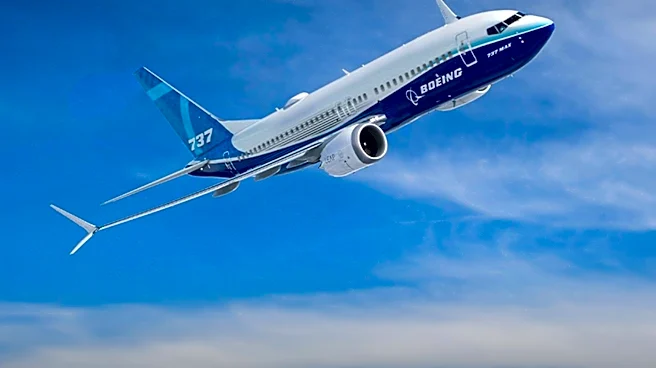
Boeing is experiencing significant production delays and expects to miss its 2026 delivery target of 500 for the 737 aircraft. The company's Commercial Airplanes segment, which generated $41.5 billion in revenue in fiscal 2025, continues to operate at a loss,
with an operating margin of negative 6.5% in fiscal Q3 2026. Boeing's overall operating margin was a loss of 0.17% over the latest twelve months, a substantial improvement from previous years but still far below the S&P 500 median. Despite these operational challenges, Boeing reported a record backlog of $745 billion in orders and its revenue grew 17.5% over the twelve months to September 30, 2026. The company is adding capacity to address production line issues and aims for a 737 production rate of 52 aircraft per month in the second half of 2027. Two new 737 models, the 737-7 and 737-10, have been certified, with deliveries expected to begin in early 2027.
Why It's Important?
Boeing's continued struggles with production and delivery targets have broad implications for the aviation industry and its investors. Airlines relying on new 737 deliveries face ongoing uncertainty in their fleet planning and expansion strategies, potentially impacting their capacity and profitability. For Boeing, the inability to meet delivery targets directly affects its revenue recognition and cash flow, contributing to the Commercial Airplanes segment's ongoing losses. While the company boasts a record backlog, converting these orders into delivered aircraft and revenue remains a critical challenge. The stock market's valuation of Boeing reflects these concerns, with shares underperforming the S&P 500. Investors are betting on Boeing's ability to resolve its production issues and turn its Commercial Airplanes unit profitable, making operational improvements a key factor in its future financial performance.
What's Next?
Boeing's immediate future will involve intense efforts to stabilize and improve its production lines for the 737 family. The company's target of reaching a production rate of 52 aircraft per month by the second half of 2027 indicates a long road ahead for recovery and efficiency gains. The commencement of deliveries for the newly certified 737-7 and 737-10 models in early 2027 will be a critical milestone to watch, as it could signal progress in overcoming some of the production bottlenecks. Management's goal of achieving approximately $10 billion in free cash flow by 2029, despite warnings of legacy cash drags in 2027, sets a high bar for operational turnaround. The company's performance in generating free cash flow, particularly in the coming quarters, will be a key indicator for investors assessing its recovery trajectory.
Beyond the Headlines
The persistent production challenges at Boeing highlight a complex interplay of factors, including supply chain disruptions, quality control issues, and the inherent complexities of modern aircraft manufacturing. This situation extends beyond immediate financial metrics, touching upon Boeing's long-term reputation and its competitive standing in the global aerospace market. The company's focus on adding capacity and addressing previous production line shortcomings suggests a deep dive into its operational methodologies. The ongoing difficulties could also influence future aircraft design and manufacturing strategies across the industry, potentially leading to greater emphasis on modularity, automation, and robust supply chain management to mitigate similar risks. Boeing's ability to navigate these challenges will not only determine its own future but also set precedents for how major aerospace manufacturers adapt to an increasingly scrutinized and demanding global market.