
What's Happening?
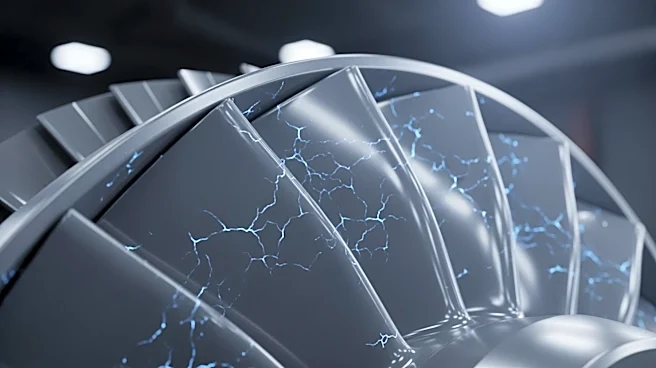
Researchers have developed a self-healing ceramic coating that can repair cracks in turbine engines at high temperatures, as detailed in a recent article in Communications Materials. The coating, inspired
by natural glaze layers in cobalt superalloys, uses cobalt oxide migration to fill cracks and protect engine components from heat damage. This innovation addresses the challenges faced by gas turbine engines, which operate under extreme thermal and mechanical stresses. The study highlights the coating's ability to enhance durability and lubricity, potentially improving engine efficiency and longevity.
Why It's Important?
This development is significant for the aerospace and energy industries, where turbine efficiency and durability are critical. The self-healing coating could lead to longer-lasting engines, reducing maintenance costs and downtime. By improving the material's resistance to thermal and mechanical stresses, the coating supports efforts to meet environmental targets and enhance engine performance. The research also opens new avenues for material science, encouraging further exploration of self-healing technologies in extreme environments.
What's Next?
Future research may focus on optimizing the coating's application process and reducing the time required for effective healing. The study's findings could lead to broader adoption of self-healing materials in various industries, including aerospace and energy. Researchers may also explore the potential for similar coatings in other high-stress environments, expanding the technology's applicability. As the coating technology advances, it could become a standard in turbine manufacturing, driving innovation in material science and engineering.