





What's Happening?
American startup Boom Supersonic has successfully tested its Sprint Core engine prototype, achieving 6,500 revolutions per minute. The trial, conducted east of Denver, involved nearly 2,000 sensors monitoring performance. This engine is initially designed
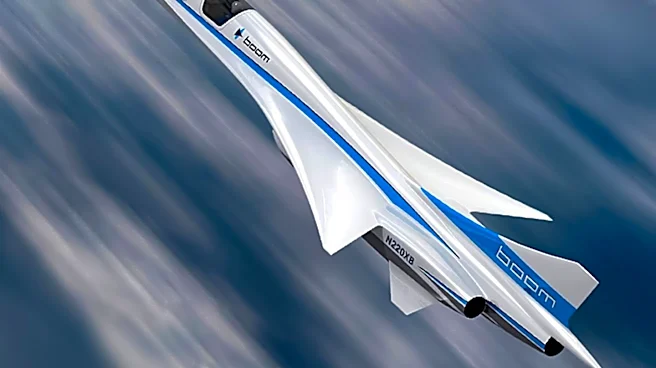
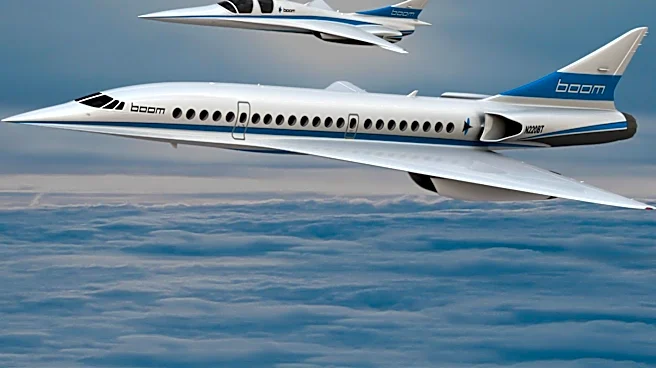
to power Superpower gas turbines, generating 42 megawatts for AI data centers. The Sprint Core will later be adapted for Boom’s Symphony engine, which will power the Overture supersonic airliner. The Overture is designed to carry 60 to 80 passengers, cruise at Mach 1.7 (approximately 1,770 km/h) at an altitude of 18.3 kilometers, and its Symphony jet engine will deliver about 178 kilonewtons of thrust. Boom Supersonic plans to manufacture heat-resistant turbine blades at its Colorado facility, with over 75% commonality in core components across different engine variants. This milestone comes despite major aerospace firms like Rolls-Royce, GE, Safran, and Pratt & Whitney declining to participate in the engine's development. Boom Supersonic has secured 130 orders and letters of intent from airlines including United, American Airlines, and Japan Airlines.
Why It's Important?
The successful test of the Sprint Core engine prototype is a significant step for Boom Supersonic, demonstrating progress in developing a viable supersonic commercial aircraft. This advancement could revolutionize air travel by drastically reducing flight times, potentially opening new routes and increasing global connectivity. The dual application of the Sprint Core engine—for both supersonic flight and powering AI data centers—highlights an innovative approach to technology development, potentially creating new revenue streams and diversifying the company's impact. The ability to generate 42 megawatts for AI data centers addresses a growing demand for energy-intensive computing infrastructure. Despite the withdrawal of major aerospace partners, Boom Supersonic's continued progress and secured orders from prominent airlines indicate market confidence in its vision. This development could intensify competition within the aviation industry, pushing other manufacturers to explore high-speed travel solutions and potentially accelerating the return of supersonic commercial flights.
What's Next?
Boom Supersonic anticipates conducting full engine testing by mid-2027. The company will continue to refine the Sprint Core engine for its eventual integration into the Symphony engine, which will power the Overture supersonic jet. Further development will focus on adapting the engine for both its aviation and energy generation applications, ensuring it meets performance and safety standards for commercial use. The manufacturing of heat-resistant turbine blades at its Colorado facility will proceed, with an emphasis on leveraging commonality across engine variants. The company will also work towards fulfilling its 130 existing orders and letters of intent from airlines like United, American Airlines, and Japan Airlines. Continued successful testing and development could lead to increased investor confidence and potentially attract new partnerships, further solidifying Boom Supersonic's position in the aerospace and energy sectors.
Beyond the Headlines
The successful Sprint Core test by Boom Supersonic signals a potential shift in the aerospace industry, moving beyond traditional subsonic air travel. This development could reignite interest in supersonic commercial aviation, which has largely been dormant since the Concorde's retirement. The dual-use nature of the engine technology, powering both aircraft and AI data centers, illustrates a broader trend of technological convergence, where innovations in one sector can find critical applications in others. This approach could lead to more sustainable and economically viable development models for advanced technologies. Furthermore, the company's ability to progress without the direct involvement of established aerospace giants challenges conventional industry structures, suggesting that smaller, agile startups can drive significant innovation. This could foster a more dynamic and competitive environment, encouraging novel engineering solutions and potentially accelerating the adoption of high-speed travel and advanced energy solutions.