





What's Happening?
A significant portion of Gen Z employees in the U.S. are reporting a lack of preparedness for their job roles and a deficit in crucial soft skills, according to recent findings. Only 39% of Gen Z individuals feel fully prepared for their positions, a 20-point
drop from the previous year. This sentiment is echoed by U.S. company leaders, with only 18% believing entry-level workers are very or completely prepared. Over two-thirds of Gen Z employees admit to feeling out of their depth at work, indicating a lack of confidence and support. To compensate for perceived undertraining, 59% of Gen Z employees are utilizing artificial intelligence (AI) to complete work tasks. This reliance on AI highlights a growing gap in human interaction and mindset skills, which AI cannot automate. The World Economic Forum identifies resilience, flexibility, and agility as highly sought-after core skills, emphasizing the need for continuous learning and adaptability.
Why It's Important?
This trend has significant implications for the U.S. workforce and economy. The reliance of Gen Z on AI for tasks due to a lack of soft skills could lead to a workforce that is technically proficient but struggles with critical human elements like collaboration, communication, and problem-solving. This deficiency could hinder innovation and effective teamwork within organizations. Companies face the challenge of equipping future employees with these essential soft skills to maintain competitiveness, especially as AI and other emerging technologies continue to transform the workplace. If not addressed, this gap could result in decreased productivity, higher turnover rates, and a less adaptable workforce. The need for a strategic shift in learning and development programs is critical to ensure Gen Z employees can perform effectively and contribute meaningfully to the evolving economic landscape.
What's Next?
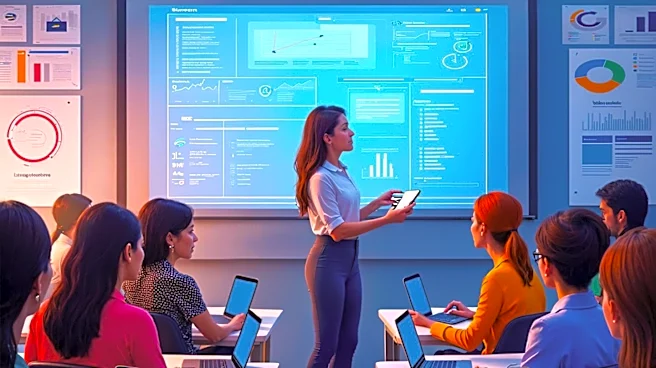
Workforce leaders are urged to re-evaluate their learning and development strategies to integrate soft skills training more effectively. This includes harnessing AI as a tool to enhance learning and creativity, rather than a substitute for critical thinking. AI can be used to prompt employees with questions and discussion starters, fostering mental muscle development. Additionally, incorporating soft skills development throughout workforce training, such as through team-based gamified learning challenges, can improve collaboration and communication. Peer-to-peer learning, including mutual mentorship programs where younger and older employees exchange knowledge, is also recommended to build confidence and support. These initiatives aim to prepare Gen Z, who are expected to be the largest generation in the workforce within a decade, for long-term success and to ensure organizations remain competitive.
Beyond the Headlines
The increasing reliance of Gen Z on AI for work tasks due to a perceived lack of preparedness raises deeper questions about the future of education and professional development. While AI offers efficiency, the potential for it to diminish critical thinking and problem-solving skills if used improperly is a concern. The emphasis on 'soft skills' — often overlooked in traditional education — underscores a fundamental shift in what constitutes a valuable employee in an AI-driven world. This situation highlights a potential ethical dilemma: are educational institutions and employers adequately preparing the next generation for a rapidly changing job market, or are they inadvertently fostering a dependency on technology that could hinder human development? The long-term societal impact could be a workforce that struggles with nuanced human interactions, potentially affecting leadership, negotiation, and complex decision-making processes.