



What's Happening?
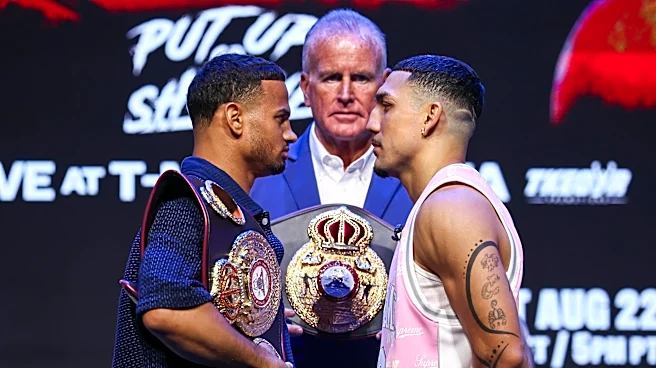
Former boxing champion James Toney has publicly dismissed Shakur Stevenson's assertion that he is the best boxer, arguing that Stevenson has not yet faced sufficiently challenging opponents. Toney, known for his career fighting elite competition, questioned
Stevenson's claim by asking, "Why? What has he done?" He emphasized that to be considered the best, a fighter must compete against the best, citing his own career and those of other legends like Roy Jones Jr. and Marvin Hagler as examples. Toney specifically mentioned Devin Haney, Gervonta 'Tank' Davis, Ryan Garcia, and Conor Benn as fighters Stevenson should face to validate his claim. This criticism follows Toney's previous remarks regarding Stevenson's safety-first fighting style, but his latest comments focus squarely on the caliber of Stevenson's opposition rather than his technique.
Why It's Important?
James Toney's critique is significant because it comes from a respected figure in boxing with a history of facing top-tier competition. His comments highlight a recurring debate in the sport: the criteria for determining a fighter's greatness. Toney's perspective suggests that true greatness is forged through challenging fights against the best available opponents, not just through an undefeated record or a particular style. This impacts Shakur Stevenson's standing in the boxing community, as a legend's public doubt can influence fan perception and future fight negotiations. For Stevenson, Toney's remarks serve as a direct challenge to prove his claims by stepping up in competition. This kind of commentary from boxing veterans often shapes the narrative around rising stars, pushing them to seek out more difficult matchups to solidify their legacy and silence critics. It also underscores the high standards and expectations placed on fighters who declare themselves the 'best' in a sport with a rich history of legendary competitors.
What's Next?
Following James Toney's pointed criticism, Shakur Stevenson will likely face increased pressure from fans and media to schedule fights against the top-tier opponents Toney mentioned, such as Devin Haney, Gervonta 'Tank' Davis, Ryan Garcia, or Conor Benn. Stevenson's response to this challenge will be crucial for his career trajectory and public image. Should he pursue and succeed in these high-stakes matchups, it would significantly bolster his claim as one of the best. Conversely, avoiding such fights might reinforce Toney's argument and lead to continued skepticism about his status. The boxing world will be closely watching Stevenson's next fight announcements to see if he takes on the challenge to prove his mettle against the sport's elite, thereby addressing the concerns raised by Toney and solidifying his position in the sport.
Beyond the Headlines
Toney's comments delve into the broader cultural and historical context of boxing, where the concept of 'the best' is deeply intertwined with a fighter's willingness to test themselves against formidable adversaries. This isn't just about wins and losses; it's about the narrative of courage, challenge, and legacy. The criticism also reflects a generational tension in boxing, where older, battle-tested champions often evaluate newer fighters through the lens of their own demanding careers. It implicitly questions whether modern boxing, with its often more carefully managed careers, produces fighters with the same level of proven grit and competitive spirit as past eras. This debate extends beyond Stevenson, touching on the sport's evolution and the enduring values that define greatness in the eyes of its most revered figures.