






What's Happening?
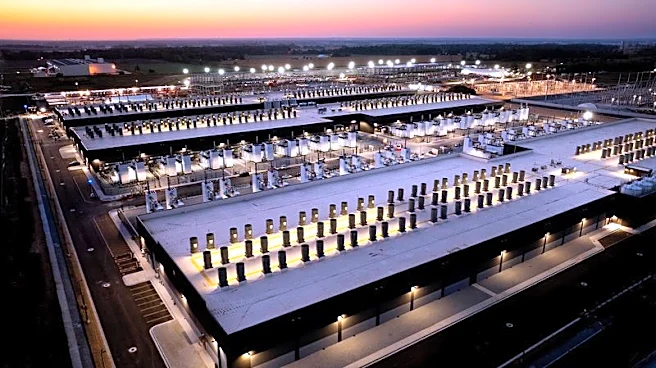
Major technology companies, including Amazon, Microsoft, Alphabet, and Meta Platforms, are projected to collectively spend $735 billion on artificial intelligence (AI) data centers by 2026. Amazon plans to allocate $220 billion, Microsoft $175 billion, Alphabet up
to $205 billion, and Meta Platforms $135 billion. While much of this investment targets GPUs, CPUs, data center rentals, and memory manufacturers, a significant portion is also flowing into the industrial sector. Companies like Caterpillar, Eaton, and GE Vernova are seeing increased demand for their products and services, which are essential for building and powering these large-scale AI infrastructures. This includes construction equipment, power generation systems, electrical distribution, and grid equipment, highlighting the broad economic impact of the AI boom beyond just semiconductor and software firms.
Why It's Important?
This massive investment by tech giants underscores the critical role of physical infrastructure in the advancement of AI. It signifies a substantial economic boost for industrial companies that provide the foundational elements for data centers, such as buildings, electricity, generators, cooling systems, and switchgear. Caterpillar, known for its construction equipment, is also benefiting from its Power & Energy segment, which supplies on-site and backup power generation solutions for energy-intensive AI data centers. Eaton, an electrical equipment company, is experiencing record revenues and a surge in its data center-related business, with data center revenue growing by 65%. GE Vernova, specializing in energy infrastructure, has seen its data center orders exceed $5 billion year-to-date, more than doubling its 2025 total. This trend indicates that the AI revolution is not solely a software or chip phenomenon but also a significant driver of growth and demand in traditional industrial sectors, creating new revenue streams and investment opportunities.
What's Next?
The continued expansion of AI initiatives by tech companies suggests sustained demand for industrial infrastructure in the coming years. Caterpillar is likely to see ongoing demand for both its construction machinery and power generation solutions as data center build-outs continue. Eaton anticipates further growth, having raised its full-year adjusted earnings-per-share guidance and organic growth projections, driven by its strong electrical backlog. GE Vernova has also increased its full-year 2026 guidance across revenue, electrification, and free cash flow, expecting its power segment to grow significantly. These companies are poised to capitalize on the long-term trend of AI infrastructure development, with their established expertise and relationships with major tech players positioning them for continued success. Investors will be watching for further updates on capital expenditure plans from tech companies and the corresponding impact on these industrial suppliers.
Beyond the Headlines
The substantial investment in AI data centers highlights a growing challenge related to energy consumption and grid capacity. AI data centers require enormous amounts of electricity, often exceeding the capabilities of existing power grids. This necessitates the development of on-site power generation solutions and significant upgrades to electrical infrastructure, creating both opportunities and pressures for utility providers and energy companies. The reliance on industrial firms for these foundational elements also underscores the interconnectedness of various economic sectors in supporting technological advancements. Furthermore, the environmental impact of such large-scale energy consumption will likely become a more prominent concern, potentially driving innovation in energy efficiency and renewable energy solutions for data centers. This trend could also lead to increased regulatory scrutiny regarding energy usage and carbon footprints within the tech industry.