





What's Happening?
SE3, a Munich-based defense tech company specializing in spatial AI for drones and autonomous systems, has successfully closed a $30 million Series A funding round. The round was led by venture capital firm Accel, with additional participation from Keen
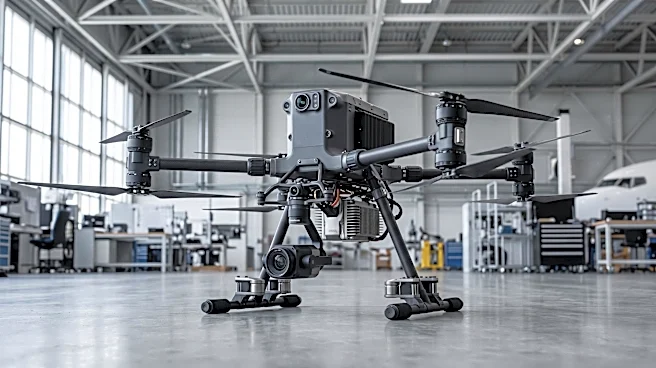
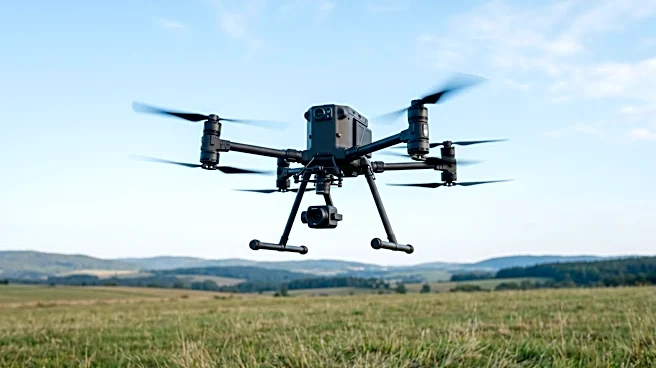
Venture Partners and existing investors Lakestar and Seedcamp. This significant investment follows SE3's emergence from stealth in June with €5.5 million in seed funding. SE3's core technology involves software that enables drones and ground vehicles to understand their surroundings by fusing sensor data into a shared 3D picture of the terrain. This system allows for the direction of entire swarms, optimizing routes and behaviors even when satellite navigation is jammed. The software operates entirely on the devices themselves and is already deployed in Ukraine, where electronic warfare frequently disrupts GPS signals.
Why It's Important?
The substantial investment in SE3 underscores the critical need for advanced autonomy in military and defense applications, particularly in environments where traditional navigation systems like GPS are compromised. The company's ability to provide spatial intelligence that allows drones to operate effectively without satellite navigation is a game-changer for modern warfare, addressing a significant vulnerability highlighted in conflicts like the one in Ukraine. For the U.S. and its allies, this technology offers a pathway to enhance the resilience and effectiveness of their drone fleets and autonomous systems in contested electromagnetic environments. The manufacturer-neutral approach of SE3's software aligns with initiatives like the Modular Open Systems Approach (MOSA) in the United States, promoting interoperability and reducing vendor lock-in, which is crucial for integrating diverse defense technologies.
What's Next?
SE3 plans to utilize the $30 million funding to expand its engineering, commercial, and operations teams, enabling the company to fulfill existing and future contracts. The company is also set to open new offices in the U.K. and plans to expand into other European countries, indicating a strategic push for broader market penetration. While defense applications will drive revenue for the immediate future, SE3 intends to explore civilian applications, such as robotics and emergency response, starting in 2027. This dual-use strategy could position SE3 as a key player in both military and commercial autonomous systems. The company's continued development of high-level fleet command AI, as noted by CEO Lukas Köstler, suggests further advancements in autonomous swarm coordination over the next one to two years.
Beyond the Headlines
SE3's success highlights a broader trend in defense technology: the increasing demand for sophisticated AI software that can operate independently of external infrastructure and across multiple hardware platforms. This shift towards software-defined autonomy is crucial for creating adaptable and resilient military systems. The company's origins from a leading computer vision and AI research department at the Technical University of Munich underscore the importance of academic research in driving cutting-edge defense innovations. Furthermore, the focus on spatial AI that allows operators to control swarms via voice commands represents a significant leap in human-machine interface, potentially simplifying complex operations and reducing cognitive load on personnel. The ethical considerations surrounding AI in warfare, particularly for a German company bound by strict export laws, also bring to light the ongoing debate about responsible development and deployment of autonomous systems.