
What's Happening?
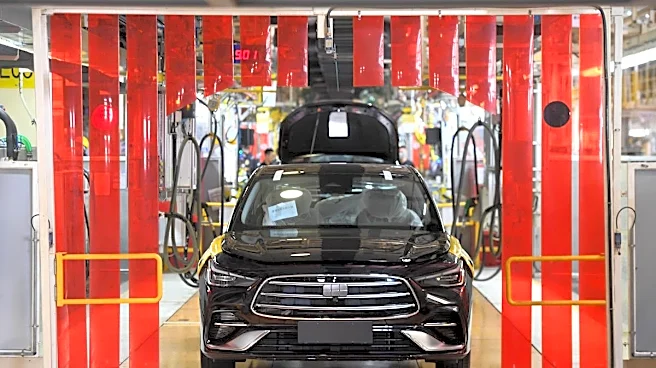
Hyundai Motor Group is intensifying its efforts in the global autonomous driving market, leveraging its extensive mass-production infrastructure, capable of producing 7 million vehicles annually, and an expanding
pool of AI-driven driving data. The company's strategy, unveiled by Park Min-woo, president and head of the AVP Division at Hyundai Motor and Kia, involves a 'data flywheel' structure. This approach uses data collected from mass-produced vehicles to refine AI models, which in turn are deployed in improved vehicles that generate even more data. Hyundai aims to surpass the cumulative driving data of leading competitors like Tesla by 2033. The roadmap includes the mass production of Nvidia-based Level 2+ self-driving systems by the first half of 2028, followed by Level 2++ systems in the second half of the same year. Furthermore, Level 2++ systems built on Hyundai's proprietary Atria AI platform are slated for mass production in the second half of 2029. The company also plans to integrate a vision-language-action (VLA) model to enhance reasoning capabilities based on visual information.
Why It's Important?
Hyundai Motor Group's aggressive push into autonomous driving signifies a major competitive shift in the automotive industry, directly challenging established leaders like Tesla. This initiative is crucial for the future of transportation, promising enhanced safety, efficiency, and convenience. For the U.S. market, increased competition in autonomous vehicle technology could accelerate innovation, potentially leading to faster adoption of self-driving cars and related infrastructure. Consumers stand to benefit from more advanced and reliable autonomous features, while the automotive sector could see significant shifts in market share and technological leadership. The development of proprietary AI platforms like Atria also highlights a broader trend of automakers seeking greater control over their core technologies, reducing reliance on third-party suppliers. This could foster new partnerships and investments in AI and software development within the U.S. tech sector, creating jobs and driving economic growth in related industries. The race to accumulate driving data is particularly important, as data volume and quality are critical for training robust AI models, making Hyundai's 2033 target a significant benchmark.
What's Next?
Hyundai's roadmap outlines several key milestones in the coming years. The mass production of Level 2+ systems is expected by the first half of 2028, followed by Level 2++ systems later that year. The introduction of Level 2++ systems based on Hyundai's Atria AI platform is scheduled for the second half of 2029. These timelines suggest a rapid deployment of advanced autonomous features into consumer vehicles. The company's focus on a 'data flywheel' strategy indicates a continuous cycle of improvement, where each generation of vehicles contributes to refining the AI for subsequent models. This will likely involve ongoing software updates and data collection efforts. Competitors, including Tesla and other major automakers, will undoubtedly respond with their own advancements and strategies to maintain or gain market share. The regulatory landscape for autonomous vehicles in the U.S. will also continue to evolve, potentially influencing the pace and scope of deployment for these technologies.
Beyond the Headlines
Hyundai's ambition to surpass Tesla in driving data by 2033 underscores the critical role of data in the autonomous driving race. This competition extends beyond mere vehicle sales; it's a battle for the most comprehensive and diverse datasets, which are essential for training AI to handle complex real-world driving scenarios. The integration of vision-language-action (VLA) models represents a significant step towards more human-like reasoning in autonomous systems, moving beyond purely reactive driving to predictive and contextual understanding. This could lead to more robust and safer self-driving capabilities. Furthermore, the development of proprietary AI platforms like Atria signifies a strategic move towards vertical integration, allowing Hyundai greater control over its technological destiny and potentially creating a competitive advantage. This trend could reshape the automotive supply chain, with software and AI becoming as critical as hardware. Ethical considerations surrounding data privacy, algorithmic bias, and the safety implications of increasingly autonomous systems will also become more prominent as these technologies advance and become more widespread.