





What's Happening?
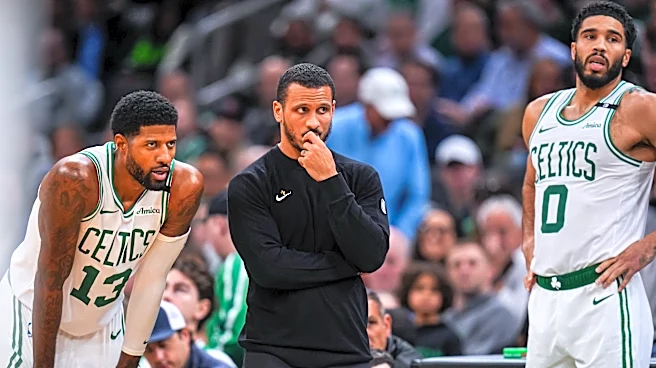
NBA Hall of Famer Tim Hardaway Sr. has issued a blunt warning to the Boston Celtics regarding their offensive strategy, specifically their heavy reliance on 3-point shooting. During an appearance on the 'Crossover Podcast' on November 18, Hardaway Sr. stated,
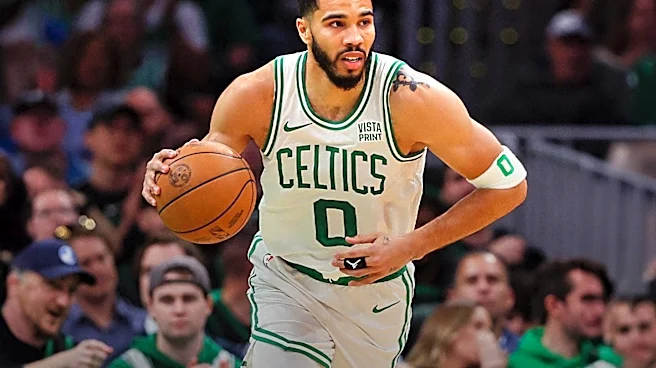
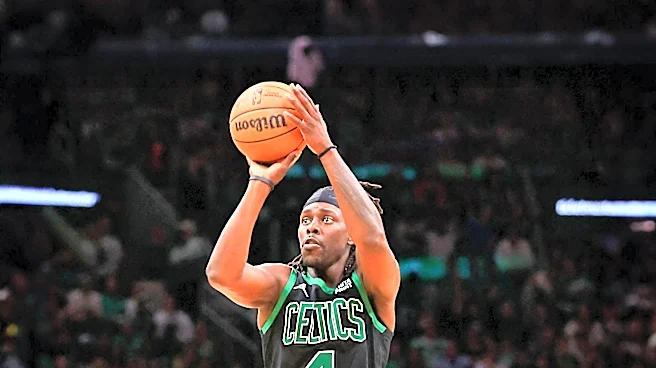
"You win by three, you die by the three," expressing skepticism about the Celtics' ability to win a championship with their current approach. He referenced the team's performance in the previous season, noting that while their 3-point shooting initially led to wins, their struggles from beyond the arc later resulted in losses. This season, the Celtics are averaging 43.9 3-point attempts per game, which is the second-highest in the NBA, and they are making 37.3% of those attempts, ranking sixth in the league. However, Hardaway Sr. highlighted instances where their shooting has faltered, such as their season-opening loss to the Detroit Pistons where they shot 3-for-11 from 3-point range in the fourth quarter, blowing a 22-point lead. Similar struggles were observed in losses to the Houston Rockets (28.6% from deep) and the Denver Nuggets (25.0% from deep).
Why It's Important?
Tim Hardaway Sr.'s critique is significant because it highlights a recurring concern about the Boston Celtics' offensive strategy, particularly their dependence on 3-point shooting. This approach, while often effective, carries inherent risks, as demonstrated by their past playoff performance and recent regular-season losses. The 'live by the three, die by the three' mentality suggests that while high-volume 3-point shooting can lead to dominant wins, it can also result in significant scoring droughts and blown leads when shots are not falling. For the Celtics, a team with championship aspirations, this warning from an NBA legend underscores a potential vulnerability that could hinder their postseason success. The team's president of basketball operations, Brad Stevens, had previously acknowledged the need for more impact at the rim after their 2026 NBA Playoffs loss, indicating that the organization is aware of the issue. Hardaway Sr.'s comments suggest that, in his view, the Celtics have not adequately addressed this fundamental imbalance, which could have long-term implications for their championship contention and overall team development.
What's Next?
The Boston Celtics will likely continue to face scrutiny regarding their offensive balance, especially as the NBA season progresses and they encounter more competitive opponents. Hardaway Sr.'s warning could prompt further internal discussions within the Celtics organization about diversifying their scoring methods and reducing their over-reliance on 3-pointers. While the team's current 3-point shooting volume and percentage are among the league's best, the concern lies in the consistency of this approach, particularly in high-pressure situations. Future games will serve as a test of whether the Celtics can maintain their shooting efficiency or if their struggles from beyond the arc will resurface, potentially impacting their standing in the Eastern Conference. The team's coaching staff and front office may need to explore strategies to create more opportunities for scoring in the paint and to develop a more versatile offensive attack to mitigate the risks associated with a perimeter-heavy game plan. The ongoing debate about their offensive philosophy will undoubtedly be a key storyline for the Celtics throughout the season.
Beyond the Headlines
The debate surrounding the Boston Celtics' 3-point heavy offense extends beyond immediate game results and touches upon broader strategic trends in modern basketball. The NBA has seen a significant shift towards 3-point shooting in recent years, with many teams adopting a 'moreyball' approach that prioritizes high-efficiency shots from beyond the arc and at the rim, while de-emphasizing mid-range jumpers. While this strategy has proven successful for many teams, Hardaway Sr.'s critique highlights the potential pitfalls of an extreme adherence to this philosophy. It raises questions about the importance of offensive versatility and the ability to adapt when a primary scoring method falters. For the Celtics, a team with a rich history and high expectations, the challenge is to find a balance that maximizes their talent while minimizing vulnerabilities. This discussion also reflects a generational divide in basketball philosophy, with older players and coaches often emphasizing a more balanced attack, while newer strategies lean heavily into analytics-driven efficiency. The Celtics' journey this season will be a case study in whether a high-volume 3-point offense can ultimately lead to a championship in today's NBA.