





What's Happening?
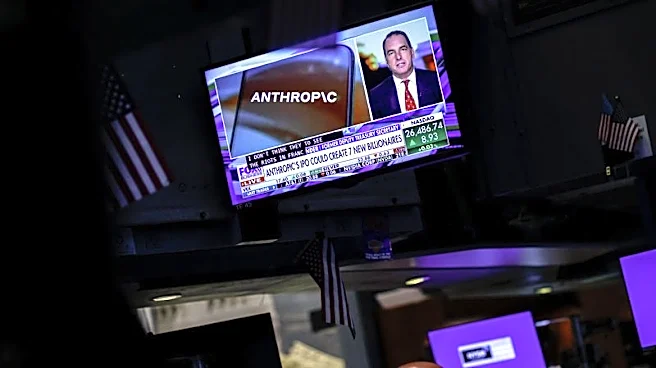
The recent Initial Public Offering (IPO) of Anthropic, an artificial intelligence company, has sparked debate regarding the viability of AI business models, as discussed on the Big Technology Podcast by Alex Kantrowitz and Ranjan Roy. Anthropic's stock,
initially priced at $83, opened at $111.50 but settled around $88 two days later. While the IPO was beneficial for the company, its staff, and early investors, everyday investors who bought at the peak experienced losses. Ranjan Roy expressed uncertainty about Anthropic's long-term business model, despite the company going public and thus opening its financial records. This situation highlights a broader bewilderment surrounding the future direction and economic implications of AI, even among those closely following the industry.
Why It's Important?
The performance of Anthropic's IPO is a significant indicator for the broader U.S. technology and investment sectors, particularly concerning the burgeoning AI industry. The initial surge followed by a quick decline suggests a speculative market environment where investor enthusiasm might outpace clear business fundamentals. This volatility could impact future AI startups seeking public funding, potentially making investors more cautious and demanding clearer paths to profitability. For the U.S. economy, a lack of clarity on AI business models could hinder sustained investment and innovation, as capital might flow to more predictable sectors. The uncertainty also affects public perception and policy discussions around AI, as stakeholders struggle to understand its true economic value and societal impact. This scenario underscores the challenge of valuing cutting-edge technologies that are still in their early stages of commercialization.
What's Next?
The mixed results of Anthropic's IPO are likely to prompt increased scrutiny from investors and analysts on the financial health and business strategies of other AI companies. Future AI IPOs may face more rigorous evaluations, with a greater emphasis on demonstrable revenue streams and sustainable growth models rather than just technological promise. This could lead to a more conservative investment landscape for AI, potentially slowing down the pace of some developments or forcing companies to pivot their strategies. Regulators and policymakers might also take note, potentially exploring frameworks to better understand and manage the economic risks associated with rapidly evolving, yet financially opaque, AI ventures. The ongoing discussions on podcasts like Big Technology will continue to shape public and investor sentiment, influencing the trajectory of the AI industry.
Beyond the Headlines
The uncertainty surrounding Anthropic's IPO and the broader AI market points to a deeper societal challenge: understanding and integrating rapidly advancing technologies. The difficulty for experts like Alex Kantrowitz and Ranjan Roy to definitively assess AI's future reflects a widespread bewilderment across various levels—from individual users to corporate strategists and political leaders. This 'bewildering' state suggests that the ethical, legal, and cultural implications of AI are still largely unaddressed or poorly understood. The rush to invest in AI without a clear grasp of its long-term economic viability could lead to market bubbles, misallocation of resources, and potential disillusionment. It also highlights the need for more transparent communication from AI companies about their operational models and for a more informed public discourse to navigate the transformative potential and inherent risks of artificial intelligence.