






What's Happening?
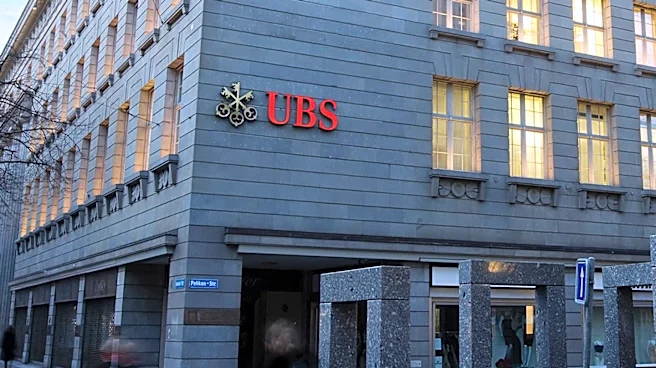
Swiss lawmakers are in the final stages of debating how much additional equity UBS Group AG should hold, a decision that will significantly influence the bank's future operations and financial strategies. An influential committee in Switzerland's lower
house is currently discussing proposals, with a key idea being to increase the Common Equity Tier 1 (CET1) backing of foreign units from 45% to 90%. Other options, such as a 75% threshold or the government's initial suggestion of 100%, are also on the table. This debate follows the collapse of Credit Suisse nearly four years ago, prompting a push to bolster the resilience of major financial institutions. UBS estimates a 90% rule would require an extra $16 billion in CET1, while the government projects a $5 billion gap, assuming offsets. The Swiss National Bank Vice President Antoine Martin has stated that 100% coverage is the best solution from a financial stability perspective, emphasizing that well-capitalized banks tend to lend more and are less prone to cutting credit during downturns.
Why It's Important?
The outcome of this legislative debate holds significant implications for UBS, its investors, and the broader financial sector. Stricter capital requirements could impact UBS's competitiveness, profitability metrics, and its capacity for investments or shareholder payouts. UBS Chief Executive Officer Sergio Ermotti has previously indicated that the bank might consider exiting Switzerland if the final law proves too severe, a sentiment echoed by some shareholders who suggest a relocation or even a combination with a major U.S. bank. The finance sector is pressing for clarity, with leaders like Zurich Insurance Group AG CEO Mario Greco and EFG International CEO Giorgio Pradelli urging lawmakers to focus on growth rather than overly stringent regulations. The decision will set the guardrails for UBS's growth and returns in the coming year, potentially affecting its ability to expand its international footprint, including its recently secured broader U.S. banking license.
What's Next?
The immediate next step involves a committee vote in Switzerland's lower house, which will provide guidance for a mid-December vote by the full chamber. If the lower house aligns with the upper house's September approval, the process could conclude. However, if the lower house diverges, the debate could extend into the next year. UBS has several potential responses to higher capital requirements, including trimming its international operations or, as a more remote possibility, relocating outside Switzerland. Some within UBS reportedly view a combination with a major U.S. bank as an appealing way to move its base. Additionally, a lower house member has proposed allowing UBS to apply more conservative valuations to foreign units, which would reduce regulatory values rather than just lowering the required percentage of backing. Regardless of the specific threshold, Algebris Investments' Chief Investment Officer, Sebastiano Pirro, believes the bank would ultimately adjust to higher capital levels.
Beyond the Headlines
The ongoing debate in Switzerland regarding UBS's capital requirements highlights a broader tension between financial stability and economic competitiveness. While the government's push aims to prevent a recurrence of events like the Credit Suisse collapse, the banking sector argues that overly stringent regulations could hinder growth and innovation. The discussion also touches upon the potential for a major global bank like UBS to consider relocating its headquarters, which could have significant economic and symbolic implications for Switzerland as a financial hub. The differing views on the 'optimal' capital level—from the government's initial 100% to the proposed 75% or 90%—underscore the complexity of balancing risk mitigation with fostering a dynamic financial industry. This legislative process could set a precedent for how other nations approach the regulation of systemically important financial institutions, particularly in an era of increasing global financial interconnectedness.