







What's Happening?
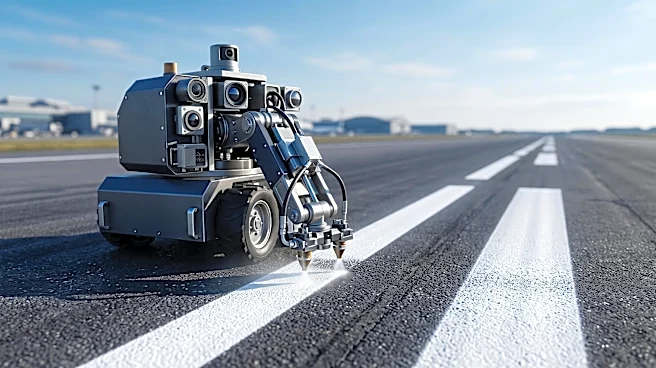
Hong Kong International Airport has become the first airport globally to implement automated robots for repainting runway markings. This initiative, developed in partnership with Shenzhen-based FJ Dynamics, involves dual-nozzle robots for straight lines
and single-nozzle models for precision turns. According to Airport Authority Hong Kong’s chief operating officer Steven Yiu Siu-chung, these robots have significantly reduced the time required for repainting. For instance, a task that previously took three hours manually can now be completed in one hour by the robots, cutting working hours by approximately two-thirds. The robots, which began operation in September after a nine-month testing period, utilize real-time kinematic (RTK) satellite navigation, integrating systems like the United States’ GPS, Russia’s GLONASS, the European Union’s Galileo, and China’s BeiDou, to achieve centimeter-level precision. They are also equipped with high-resolution RGB cameras and LiDAR, allowing them to automatically stop upon detecting obstacles. This deployment is part of the airport's broader strategy to incorporate robotics into maintenance, which also includes runway sweepers, rubber-removal vehicles, and lawn-mowing robots.
Why It's Important?
The deployment of automated runway-painting robots at Hong Kong International Airport signifies a notable advancement in airport operations and maintenance, with potential implications for efficiency and cost-effectiveness across the aviation industry. The reported reduction in working hours by two-thirds and an estimated annual saving of HK$400,000 in paint costs highlight the economic benefits of such automation. This innovation addresses the challenge of recruiting staff for demanding overnight maintenance work, easing the workload on human teams and allowing them to focus on more complex tasks. The use of advanced satellite navigation systems, including the U.S.'s GPS, underscores the global collaboration and technological sophistication required for such precise operations. For U.S. airports and aviation stakeholders, this development could serve as a blueprint for adopting similar robotic solutions to enhance operational efficiency, reduce labor costs, and improve safety by minimizing human exposure to hazardous runway environments. The success of this hybrid approach, combining robotic automation with human oversight, could influence future investment and policy decisions regarding infrastructure maintenance in the U.S. and beyond.
What's Next?
The Hong Kong International Airport anticipates a long-term hybrid approach to runway maintenance, where robots handle routine repainting while human staff manage more complex procedures. This model is expected to further alleviate the workload on maintenance teams. The successful implementation and demonstrated benefits of these robots could prompt other major international airports, including those in the U.S., to explore similar automation technologies. Further advancements in robotic capabilities, such as enhanced obstacle detection and navigation in varying weather conditions, could expand their utility. The integration of multiple global satellite systems for precision navigation also suggests a trend towards more interconnected and resilient autonomous systems. Future developments may include the expansion of robotic applications to other areas of airport operations, potentially leading to a more automated and efficient aviation infrastructure worldwide. The data collected from these operations will likely inform the development of next-generation autonomous maintenance solutions.
Beyond the Headlines
The adoption of automated runway-painting robots at Hong Kong International Airport reflects a broader global trend towards automation and artificial intelligence in critical infrastructure management. This shift raises important questions about the future of labor in industries traditionally reliant on manual work. While the immediate impact is a reduction in demanding overnight shifts, the long-term implications for employment patterns and workforce training need consideration. The reliance on multiple satellite navigation systems, including those from the U.S., Russia, the EU, and China, also highlights the increasing interdependence of global technological infrastructures and the potential for both cooperation and competition in the development of autonomous systems. Furthermore, the precision and efficiency offered by these robots could set new industry standards for safety and operational consistency, potentially influencing regulatory frameworks for airport maintenance globally. This development underscores the ethical considerations surrounding the deployment of autonomous systems in safety-critical environments, emphasizing the need for robust testing and fail-safe mechanisms.