





What's Happening?
Mexico is promoting a 'dry canal' land corridor, known as the Interoceanic Corridor of the Isthmus of Tehuantepec (CIIT), as a new alternative for global trade amidst disruptions in major waterways like the Panama Canal, the Strait of Hormuz, and the Red
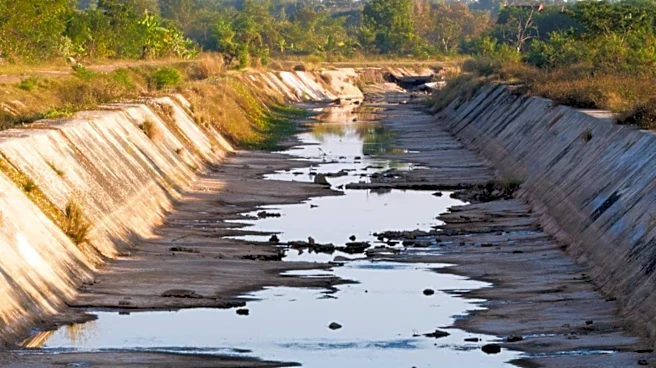
Sea. Since 2019, Mexico has invested at least $4 billion to develop this 190-mile rail link between a port in the Gulf of Mexico and another on the Pacific coast. The investment includes rehabilitating over 500 miles of railway, upgrading infrastructure, modernizing ports, and acquiring land for industrial development. The CIIT aims to complement the Panama Canal, which has experienced significant delays due to droughts, and offer a new route for freight containers. The project is also part of a broader effort to boost economic activity in southern Mexico, a region with high poverty rates. Mexican officials are working to attract manufacturers to set up plants along the corridor, creating a consistent flow of cargo.
Why It's Important?
This initiative is significant for global trade and U.S. economic interests as it offers a potential solution to supply chain vulnerabilities exposed by disruptions in traditional shipping routes. The Panama Canal's issues, exacerbated by the El Niño weather phenomenon, have led to increased wait times and costs, directly impacting goods destined for the U.S. The CIIT could provide a more reliable and faster transit option for cargo, potentially reducing shipping times and costs for businesses. For Mexico, the project is a critical opportunity to stimulate investment and economic growth in its southern regions, addressing long-standing issues of poverty and underdevelopment. The success of the CIIT could also strengthen Mexico's position as a key trade partner for the U.S., especially in the context of nearshoring trends, where companies seek to relocate manufacturing closer to the U.S. market. The project's ability to attract manufacturing and generate consistent cargo flow will determine its long-term impact on regional and international trade dynamics.
What's Next?
Mexico is actively working to attract investment and cargo to the CIIT. The government has revised its concession model for the 14 planned 'development hubs' (industrial parks) along the corridor, offering more flexible terms and incentives to investors. These changes include scrapping a 25% down payment requirement for land and providing longer concession periods with options to purchase land if investment targets are met. President Claudia Sheinbaum has made the corridor a priority, holding bi-weekly progress reviews. Officials anticipate that the corridor could move 1.4 million containers annually by 2035, though this is a fraction of the Panama Canal's current volume. The focus is now on overcoming challenges such as limited natural gas supply, weak road connections, insufficient basic services, and legal uncertainties to make the corridor a viable logistical option. The Navy is also working on building an electrical substation to address power constraints for energy-intensive projects.
Beyond the Headlines
The 'dry canal' project represents a long-standing ambition for Mexico, with historical roots dating back over a century. Its current revival highlights the increasing geopolitical and environmental pressures on global supply chains, making alternative trade routes more appealing. The project's success hinges not only on its logistical efficiency but also on its ability to transform the economic landscape of southern Mexico. This involves addressing deep-seated issues of poverty and lack of infrastructure in a region historically overlooked for development. The initiative also underscores the broader trend of nearshoring, where companies are re-evaluating their supply chain strategies to mitigate risks. While the CIIT offers a strategic location and potential for faster transit, its long-term viability will depend on overcoming significant infrastructural and economic challenges, as well as convincing global trade to shift established patterns. The project's ethical and social implications, particularly concerning land acquisition and local community development, will also be crucial factors in its overall success and acceptance.