
What's Happening?
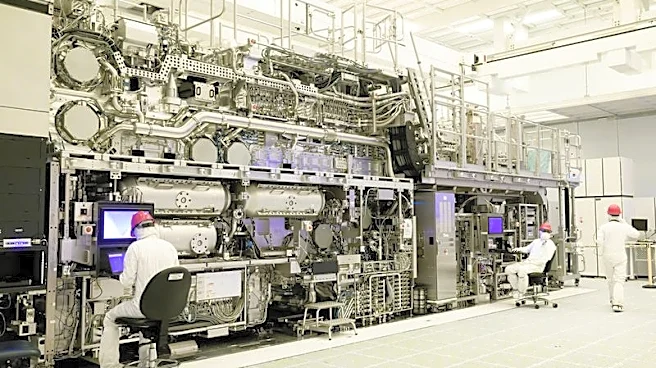
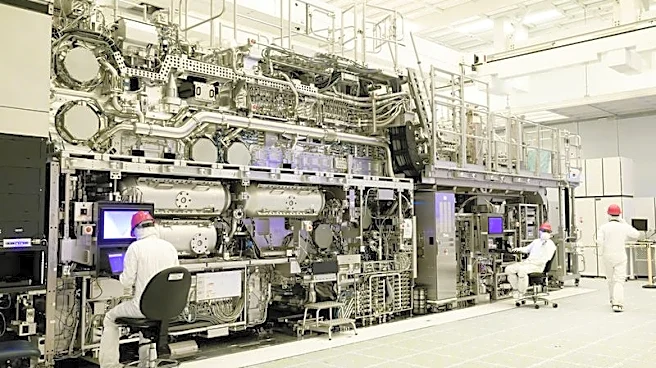
China has initiated the production of domestic immersion deep-ultraviolet (DUV) lithography tools, as reported by Reuters. The state-backed Shanghai Aishengna Electronic Technology Group is set to deliver
these machines to companies like Semiconductor Manufacturing International, Hua Hong Semiconductor, and ChangXin Memory Technologies. The production is expected to be limited, with approximately five systems in 2026 and about 20 in 2027. This development poses a direct challenge to ASML Holding N.V., which has been restricted from selling its advanced extreme-ultraviolet systems to China due to export controls. ASML's DUV scanners, which accounted for 29% of its 2025 net sales, are now at risk of being substituted by these domestic machines.
Why It's Important?
The emergence of China's domestic DUV lithography tools represents a strategic shift in the semiconductor industry, potentially reducing China's reliance on foreign technology. For ASML, this development could lead to a decrease in future sales and service revenue from Chinese fabs, impacting its financial performance. For Micron Technology, the situation presents a competitive threat as ChangXin Memory Technologies, a recipient of the new tools, competes in the DRAM market. If these tools become viable, they could increase supply and pressure industry pricing, affecting Micron's margins. This shift could alter the global semiconductor supply chain dynamics and influence pricing and availability of memory products.
What's Next?
The Chinese DUV systems still require further testing to match ASML's performance and reliability. If successful, these tools could gradually replace ASML's products in China, impacting its market share. For Micron, the potential increase in DRAM supply from China could lead to pricing pressures, necessitating strategic adjustments. Industry stakeholders will closely monitor the performance and adoption of these domestic tools. The broader implications for the semiconductor industry include potential shifts in global supply chains and increased competition in the memory market.