



What's Happening?
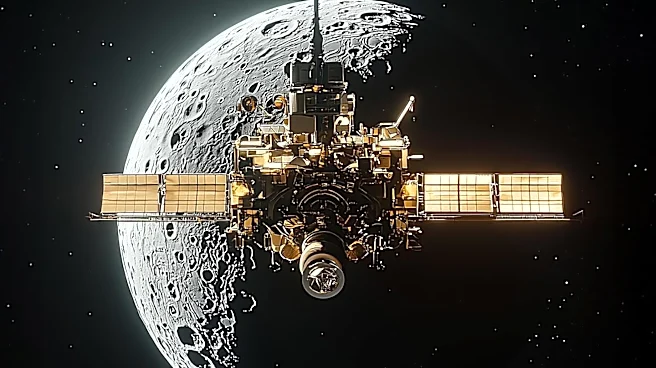
Firefly Aerospace has announced a commercial payload agreement with Starcloud for an artificial intelligence (AI) computing payload. This payload is designed to test data center technology in lunar orbit and will fly aboard a Firefly Aerospace Elytra
orbital vehicle. The announcement was made on September 30. The Starcloud SC-1L processor will be part of Firefly’s third lunar mission, which is targeted for no earlier than 2028. The primary goal of this demonstration is to evaluate capabilities for a future lunar data center that would support both surface and orbital infrastructure. According to Ray Allensworth, vice president of spacecraft at Firefly Aerospace, the collaboration aims to demonstrate how data can be captured, processed, and delivered from lunar orbit by integrating Starcloud’s AI computing payload with the Elytra vehicle and its Solux vision system. Ezra Feilden, co-founder and chief technology officer of Starcloud, emphasized that the mission will showcase high-power AI computing and the ability to process large volumes of data directly where it is generated. Firefly did not disclose the financial terms of the agreement or confirm if it is a signed contract.
Why It's Important?
This initiative marks a significant step towards establishing advanced data processing capabilities in space, particularly in lunar orbit. The development of a lunar data center could revolutionize how data from lunar missions and future lunar bases are handled, reducing reliance on Earth-based infrastructure for immediate processing. This could lead to faster decision-making, more efficient resource utilization, and enhanced scientific research on the Moon. For the U.S. space industry, this project highlights the growing trend of commercial partnerships in space exploration and the increasing role of private companies in developing critical space infrastructure. It also underscores the strategic importance of AI and edge computing in future space endeavors, enabling more autonomous and data-intensive operations. The success of this demonstration could position Firefly Aerospace and Starcloud as key players in the emerging lunar economy, potentially attracting further investment and fostering innovation in space technology. The ability to process data in orbit could also have implications for national security and defense applications, providing more resilient and secure data handling capabilities beyond Earth's immediate vicinity.
What's Next?
The next major step for this project is the launch of Firefly’s third lunar mission, which is currently targeted for no earlier than 2028. Prior to this, Firefly plans to send its first Elytra vehicle to lunar orbit on Blue Ghost Mission 2, scheduled for no earlier than 2027. The Elytra’s initial task on the Starcloud mission will be to serve as a transfer vehicle and communications relay for a Blue Ghost lander heading to the Moon’s Gruithuisen Domes under NASA’s Commercial Lunar Payload Services program. Following this, the Elytra will remain in lunar orbit for five years to support customer payloads and imaging, including the Starcloud demonstration. The SC-1L processor will collect data from the Elytra’s Solux vision system, process it in orbit, and transmit the results back to Earth. This will extend Starcloud’s AI computing work from low Earth orbit to lunar orbit. The outcome of these missions will determine the feasibility and scalability of lunar data centers, influencing future lunar exploration and commercial ventures.
Beyond the Headlines
The concept of a lunar data center extends beyond mere data processing; it represents a foundational element for a sustained human presence on the Moon and potentially beyond. By enabling on-site data analysis, it could significantly reduce communication latency and bandwidth requirements, which are critical challenges for deep space missions. This could foster a more independent and robust lunar ecosystem, where scientific experiments, resource extraction, and even manufacturing can operate with greater autonomy. Ethically, the establishment of data centers in space raises questions about data ownership, privacy, and the governance of information in extraterrestrial environments. Legally, international frameworks will need to evolve to address these new forms of space infrastructure and the data they manage. Culturally, this development could shift public perception of space from a distant frontier to a more accessible and economically viable domain, inspiring new generations to pursue careers in space science and technology. The long-term implications include the potential for a distributed network of data centers across the solar system, supporting a multi-planetary civilization.