




What's Happening?
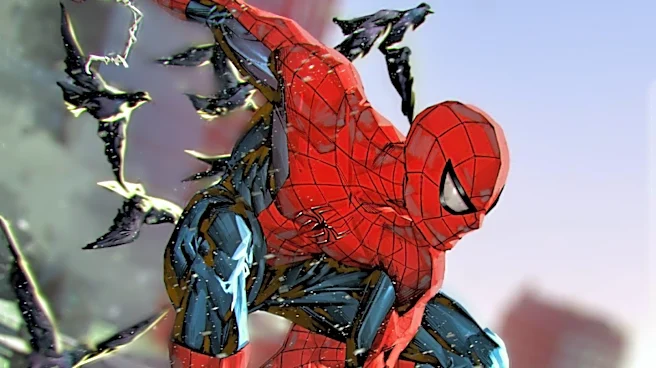
Artificial intelligence has produced a series of concept images depicting a dark, sci-fi horror version of 'Spider-Man,' drawing inspiration from filmmakers like James Cameron, Ridley Scott, and David Cronenberg. These AI-generated visuals portray a gloomy,
futuristic New York City where technology has advanced, and characters are often enhanced by it. The concept includes terrifying renditions of Venom, a technologically enhanced Spider-Man suit, and a body horror-inspired Doctor Octopus. While the AI concept is visually striking and unique, it deviates significantly from James Cameron's actual plans for his unproduced 'Spider-Man' film in the 1990s. Cameron's vision was intended to have a mature edge but was never conceived as a dark, horror-heavy sci-fi picture akin to his works like 'Terminator' or 'Aliens.' Despite his version not being made, some elements from Cameron's original script were incorporated into the 2002 'Spider-Man' movie.
Why It's Important?
This development highlights the growing capabilities of AI in creative fields, particularly in generating visual concepts for entertainment properties. The ability of AI to synthesize stylistic elements from various directors and genres to create new interpretations of established franchises demonstrates its potential as a tool for concept artists and filmmakers. However, it also raises questions about creative intent and fidelity to original visions, as the AI's output can diverge significantly from a creator's actual plans. For the entertainment industry, AI could streamline early-stage visual development, offering diverse stylistic explorations quickly. For audiences, it provides novel, albeit unofficial, interpretations of beloved characters, potentially sparking new discussions about how these stories could be told. The contrast between the AI's horror-centric 'Spider-Man' and Cameron's intended 'mature edge' version underscores the difference between algorithmic generation and human artistic direction.
Beyond the Headlines
The emergence of AI-generated content like this 'Spider-Man' concept delves into deeper implications regarding authorship and artistic interpretation. While AI can mimic styles and generate new visuals, it lacks the nuanced understanding of narrative, character, and thematic intent that human creators possess. This particular AI concept, by taking cues from horror directors, transforms 'Spider-Man' into something far removed from its core identity, which is typically more heroic and less grim. This raises ethical questions about how far AI should be allowed to reinterpret established intellectual properties without direct creative oversight. It also points to a future where AI might become a common tool for fan art and speculative projects, blurring the lines between official and unofficial content. The discussion around such AI creations often revolves around whether they are innovative artistic expressions or merely algorithmic pastiches, and how they might influence audience expectations for future adaptations.