


What's Happening?
Pop star Pink has addressed the backlash she received after criticizing Macklemore's anti-Israel remarks made during his performances opening for Ed Sheeran at MetLife Stadium. Macklemore, whose real name is Benjamin Hammond Haggerty, called to 'Free
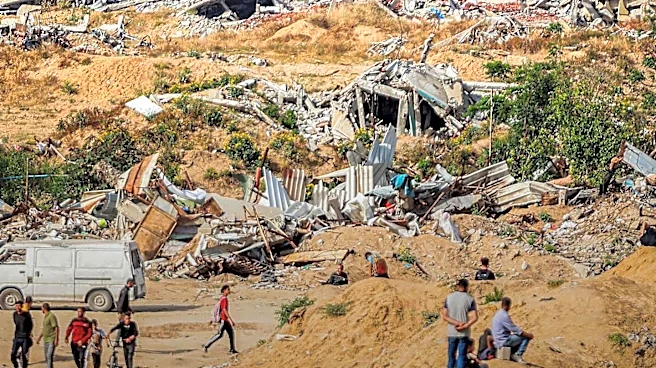
Palestine' and accused Israel of committing genocide, performing his song 'Hind's Hall' with a slideshow of footage from the war in Gaza. Pink reshared a video from StopAntisemitism on Instagram, which criticized Macklemore and called for his removal from Sheeran's tour. This post led to accusations from fans that Pink was pro-Israel. In response, Pink issued a statement on Instagram, clarifying her position. She stated, 'I was born a Jew. I didn’t pick it, and I’ve never hidden it.' She emphasized that she does not speak for Israel or any government, reiterating her belief that Hamas is a terrorist organization and Palestinians deserve a future that honors their humanity. Pink also highlighted her objection was not to the phrase 'Free Palestine,' but to Macklemore's actions, recalling a past incident where he wore a costume perceived as antisemitic and his recent performance where he told 'all of the Jews in the stadium that it wasn’t about them.' She expressed that his comments scared her as a Jewish mother and the people she loves, but clarified she does not want him fired or silenced.
Why It's Important?
This incident highlights the increasing tension and polarization surrounding the Israel-Palestine conflict within the entertainment industry and public discourse in the U.S. Pink's decision to speak out, particularly as a Jewish artist, underscores the personal and emotional impact of the conflict on individuals and communities. The swift backlash she faced, and her subsequent detailed response, illustrate the challenges public figures encounter when navigating such sensitive geopolitical issues. It also reflects a broader societal struggle to differentiate between criticism of a government's policies and accusations against an entire people or religion. The event brings to the forefront the debate over freedom of expression for artists and the potential consequences of their political statements, especially when those statements are perceived as inflammatory or one-sided. The public's reaction, ranging from support to condemnation, demonstrates the deep divisions and strong feelings that the conflict evokes, making it difficult for any public figure to take a stance without facing significant scrutiny.
What's Next?
The ongoing debate is likely to continue, with both artists and their respective fan bases further engaging in discussions about the Israel-Palestine conflict. Macklemore has stood by his remarks, explaining that he chose to tour with Ed Sheeran partly to use the platform to say 'Free Palestine' to a large audience, stating, 'Wanting all humans to be treated equal should never be controversial.' The Israeli-American Council has launched a petition calling for Macklemore's removal from the remaining U.S. stadium shows where he is scheduled to open for Sheeran. This suggests potential further pressure on concert organizers and artists to address the political statements made during performances. The incident may also encourage other public figures to either voice their opinions more cautiously or, conversely, to take more definitive stances, potentially leading to more public discussions and controversies within the entertainment sphere regarding geopolitical issues.
Beyond the Headlines
This situation delves into the complex interplay between celebrity influence, political activism, and identity in contemporary American culture. Pink's statement, particularly her emphasis on being a 'Jewish mom' and her historical political activism, highlights how personal identity and experiences shape public engagement with global conflicts. The incident also touches upon the concept of 'cancel culture' and the pressure on public figures to align with certain political narratives, often at the risk of alienating segments of their audience. The use of social media platforms by both artists to communicate their stances and by the public to react amplifies the reach and intensity of these debates. It underscores a shift where entertainment is increasingly intertwined with political and social commentary, challenging the traditional boundaries between art and activism. The differing interpretations of 'Free Palestine' and the accusations of antisemitism or anti-Zionism reveal a deeper societal struggle to engage in nuanced conversations about complex international issues without resorting to oversimplification or personal attacks.