






What's Happening?
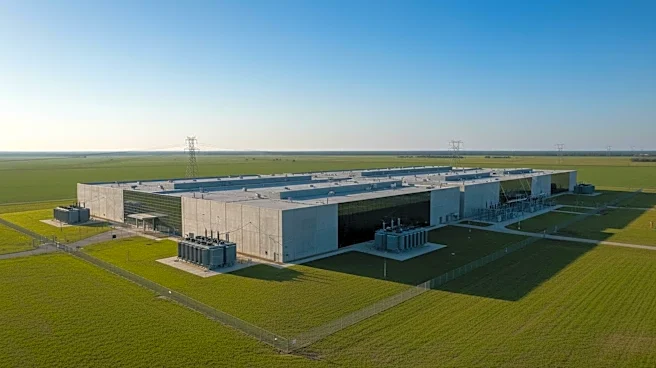
The Louisiana Public Service Commission (LPSC) has rejected a subpoena that would have compelled Meta to disclose more details about its AI data center, Hyperion, in Richland Parish, Louisiana. This decision comes as Entergy Louisiana, the state's largest
utility company, seeks approval to construct seven additional gas-fired power plants to support the data center's expansion. These new plants would be in addition to three gas plants already approved, bringing the total to ten. The proposed expansion, which includes new transmission and infrastructure, is projected to require 7,540 MW of power, an amount six times greater than the annual peak demand of New Orleans. Community members and advocacy groups, including the Union of Concerned Scientists (UCS) and the Alliance for Affordable Energy (AAE), have raised concerns about the environmental impact, potential rate hikes for existing customers, and a lack of transparency from Meta regarding job creation and electricity demand. Despite a judge's earlier ruling that more information from Meta was necessary, three out of four LPSC commissioners voted to quash the subpoena.
Why It's Important?
This development is significant for Louisiana ratepayers and the broader energy landscape. The rejection of the subpoena means that Meta will not be required to provide detailed information on its investment, permanent job creation, or precise electricity demand, leaving stakeholders with incomplete data to assess the project's true impact. Entergy Louisiana claims the data center will benefit existing customers, but critics argue that the proposal could lead to substantial rate hikes, as Meta has not agreed to cover all power costs. The arrangement includes a 20-year contract with minimum charges, but ratepayers could still be responsible for remaining capital costs if Meta terminates the contract early, or for operating costs not included in Meta's minimum charges, such as fuel adjustment clause (FAC) costs. Furthermore, Entergy's analysis of power grid reliability and cost-effectiveness has been criticized for relying on optimistic assumptions and for not exploring alternative solutions like data center load flexibility or more advanced transmission line designs. The project's scale, involving over $15 billion in new capital infrastructure, raises concerns about potential financial risks for Louisiana residents.
What's Next?
The regulatory proceeding at the Louisiana Public Service Commission (LPSC) is ongoing, with a final decision on Entergy's proposal to build the seven additional gas plants scheduled for December 16, 2026. Stakeholders, including the Union of Concerned Scientists and the Alliance for Affordable Energy, will continue to weigh in on the proposal, advocating for greater transparency and protection for ratepayers. The LPSC is expected to make a decision on whether to approve the construction of the additional power plants and associated infrastructure. There is a call for the Commission to require Entergy to further study grid-reliability issues and consider a more staggered review schedule for the multi-billion-dollar project. Additionally, the LPSC is urged to ensure that Entergy's shareholders share the financial risks associated with the project, rather than placing the entire burden on ratepayers, especially given the estimated $8 billion in profits shareholders could make over a 20-year period if the construction projects are approved.
Beyond the Headlines
The situation in Louisiana highlights a growing national challenge: balancing the economic benefits of attracting large-scale technology infrastructure, such as AI data centers, with the environmental and financial costs borne by local communities and ratepayers. The lack of transparency from a major tech company like Meta, coupled with regulatory decisions that limit public access to critical project details, raises questions about corporate accountability and the public interest. The reliance on new gas-fired power plants to meet the immense energy demands of AI operations also underscores the tension between technological advancement and climate goals. This case could set a precedent for how states regulate the energy consumption of data centers and how utilities are allowed to pass on associated costs to consumers. It also brings to light the potential for utilities to profit from large construction projects, even if those projects carry significant risks for ratepayers, especially when regulatory processes are expedited or lack thorough scrutiny of alternative, potentially cleaner, and more cost-effective solutions.