



What's Happening?
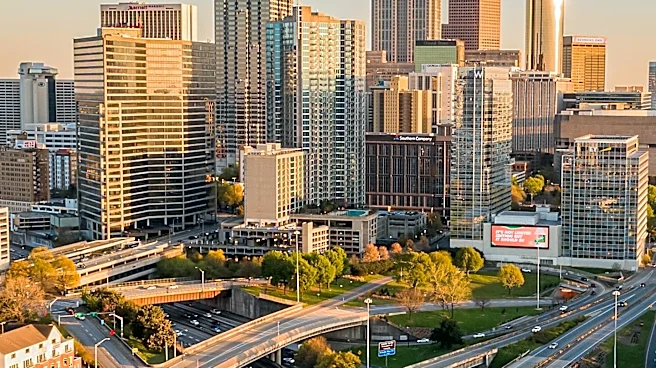
Georgia-Pacific Inc. has abandoned its plans to convert a significant portion of its Atlanta headquarters into residential units, citing prohibitive project costs and broader market headwinds. The company had intended to create 400 apartment units on the
upper floors of the 51-story Georgia-Pacific Center, along with 125,000 square feet of retail and entertainment space and a 35,000 square-foot central plaza. Suzanne Maynard, head of real estate development at Georgia-Pacific, confirmed the decision, stating that the economic viability of the project at its planned scale was compromised. The Georgia-Pacific Center, opened in 1982, was one of ten proposed office-to-residential conversions in the Atlanta metropolitan area. While the company will not proceed with the residential conversion, it plans to focus resources on critical infrastructure improvements, modernized building systems, and upgraded amenities within the existing office space.
Why It's Important?
This decision by Georgia-Pacific highlights the significant financial challenges associated with office-to-residential conversions, even in a market with high demand for housing. The project's cancellation underscores that while such conversions are seen as a solution for vacant office spaces and housing shortages, the high costs, ranging from $150 to $400 per square foot or more, often make them economically unfeasible without substantial subsidies. This case could deter other private developers from pursuing similar large-scale conversions, particularly for older buildings like the Georgia-Pacific Center, which was constructed in the 1980s and may present structural or design challenges for residential adaptation. The broader implication is that the national trend of increasing office-to-residential conversion projects, which has seen a fourfold increase in the pipeline since 2022, may face significant hurdles if financial viability remains a primary concern for developers.
What's Next?
Following the cancellation, Georgia-Pacific will redirect its investment towards enhancing its existing office infrastructure, including building systems and amenities, to improve the workplace environment for its employees. This shift suggests a focus on retaining and optimizing its current office footprint rather than diversifying into residential real estate. For Atlanta, the city's economic development arm, Invest Atlanta, is still moving forward with a separate project to convert the 44-story 2 Peachtree St. into affordable housing, indicating that publicly supported conversions may continue despite private sector setbacks. However, the challenges faced by Georgia-Pacific could lead to increased scrutiny and a more cautious approach from other developers considering similar projects, potentially necessitating greater public incentives or innovative financing models to make such conversions viable in the future.
Beyond the Headlines
The Georgia-Pacific decision reveals a deeper tension between urban revitalization goals and the economic realities of real estate development. While converting vacant office buildings into housing addresses critical needs like housing shortages and downtown revitalization, the inherent costs and complexities often outweigh the potential benefits for private entities. This situation prompts questions about the role of government in incentivizing or subsidizing such projects to achieve broader societal goals. It also highlights the architectural and structural limitations of converting certain types of office buildings, particularly those from earlier eras, which may not be well-suited for residential layouts. The outcome in Atlanta could serve as a case study for other U.S. cities grappling with similar challenges, pushing for more realistic assessments of conversion feasibility and potentially fostering new approaches to urban development that balance economic returns with community needs.