




What's Happening?
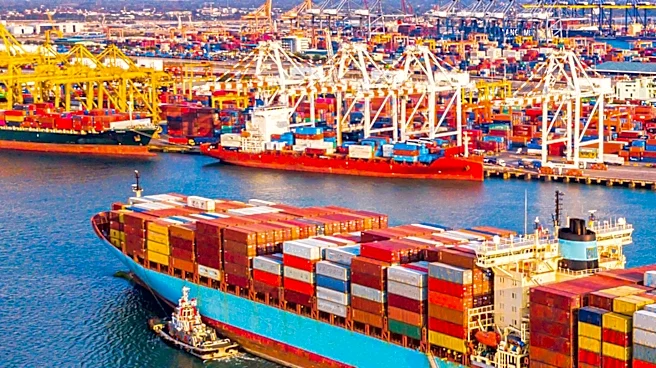
The global trade system is increasingly moving beyond single chokepoint infrastructure like the Panama Canal towards a network of multimodal connectivity. This shift is driven by growing geopolitical uncertainties and environmental pressures, such as climate
change impacting water availability for canals. The Panama Canal, while historically transformative, illustrates the vulnerabilities of concentrated flows, which can be disrupted by congestion, accidents, geopolitical events, or environmental factors. Recent disruptions, including the war in Eastern Europe affecting Eurasian land transport and conflicts in the MENA region impacting Red Sea and Suez corridor shipping, highlight the need for alternative, interoperable routes. The concept of an 'Atlantic–Pacific bridge' is evolving from a single corridor to a resilient ecosystem of maritime routes, railways, ports, logistics systems, and governance institutions. Central America, with its multiple potential interfaces between the Atlantic and Pacific, is seen as a prime region for developing such multimodal systems, integrating various transport modes to enhance resilience and flexibility in global supply chains.
Why It's Important?
This evolution in global connectivity is crucial for enhancing the resilience of international trade against a backdrop of increasing volatility. Over-reliance on single chokepoints creates systemic exposure, making supply chains vulnerable to disruptions that can rapidly propagate across continents. By developing multimodal networks, the global economy can mitigate risks associated with geopolitical shocks, climate change impacts, and other unforeseen events. This approach allows for greater flexibility, enabling cargo to shift between different transport modes (maritime, rail, road) based on capacity, cost, time, security, and environmental conditions. The strategic importance extends to critical areas like food security, as diversified interoceanic systems can provide more reliable and affordable transport for essential commodities, reducing price volatility and shortages. For businesses, this means more robust supply chains, reduced transit risks, and potentially lower insurance premiums, while for governments, it implies greater economic stability and national security.
What's Next?
The future will likely see increased investment and development in integrated multimodal transport systems, particularly in regions like Central America. Discussions around projects like a Nicaraguan interoceanic canal may shift from being a competitor to Panama to becoming part of a broader, complementary multimodal system. International cooperation will be essential to establish interoperable rules and governance frameworks that ensure consistent application of maritime law across these diverse routes. Stakeholders, including shipping companies, logistics providers, and national governments, will need to collaborate on developing the necessary infrastructure, digital platforms, and regulatory environments to support these complex networks. The focus will be on creating redundancy and strategic optionality within the global connectivity system, moving towards an ecosystem where various transport modes reinforce one another rather than operating in isolation.
Beyond the Headlines
The shift towards multimodal connectivity reflects a deeper understanding of systemic risk in a hyper-globalized world. It challenges the traditional paradigm of seeking efficiency through concentration, instead prioritizing resilience through diversification and interoperability. This approach also highlights the evolving role of geography; while infrastructure can transform geographical constraints, it cannot eliminate them. The emphasis on governance and the consistent application of international maritime law underscores a critical, often overlooked, aspect of global trade: predictability. When international rules are perceived as negotiable for powerful actors, it undermines the credibility of the entire system, transferring risk into economic costs. This evolution also has environmental implications, as future infrastructure planning must integrate climate resilience from the outset, recognizing that ecological systems are integral to operational capacity, as seen with water availability for canals. Ultimately, this represents a strategic re-evaluation of how global trade can be sustained in an era of increasing uncertainty.