









What's Happening?
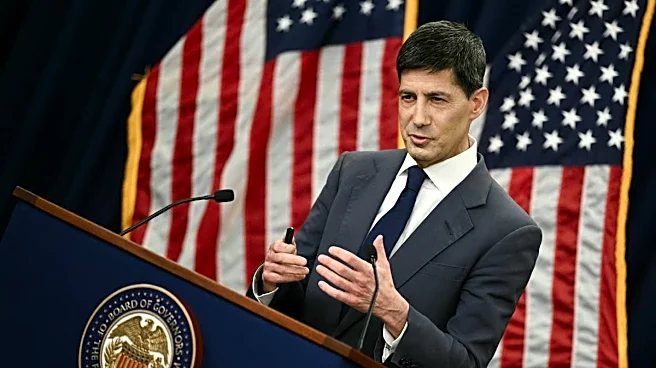
Kevin Warsh, the new chair of the Federal Reserve, has initiated a shift towards less transparency in the Fed's communications, a move that could lead to increased market volatility. In his first press conference, Warsh reduced the length of the Fed's interest-rate
decision statement and eliminated forward guidance, which has traditionally helped stabilize market expectations. This change is part of Warsh's belief that financial markets have become overly reliant on Fed guidance, and he aims to encourage investors to make independent assessments based on economic data. The immediate market reaction included fluctuations in stock and bond prices, with the yield on the 10-year Treasury note rising, which could lead to higher borrowing costs for consumers and businesses.
Why It's Important?
Warsh's approach represents a significant departure from the Fed's recent trend towards greater transparency and communication. By reducing forward guidance, the Fed risks creating uncertainty in financial markets, which could lead to more volatile swings in asset prices. This could have broader economic implications, potentially affecting consumer confidence and business investment decisions. The shift also raises questions about the Fed's ability to manage expectations during economic downturns or crises, where clear communication has historically played a crucial role in stabilizing markets. The decision to reduce transparency may also impact the Fed's credibility and its relationship with financial markets, as investors adjust to the new communication strategy.
What's Next?
The Federal Reserve's new communication strategy will be closely watched by financial markets and policymakers. If market volatility increases, the Fed may face pressure to revert to more transparent practices. Additionally, Warsh's approach will be tested in the event of an economic downturn or financial crisis, where the lack of forward guidance could complicate the Fed's ability to manage market expectations. The Fed's internal task forces, announced by Warsh, will explore potential reforms to its operations, including communication strategies, which could lead to further changes in how the Fed interacts with markets. Stakeholders, including investors and economists, will be keenly observing the impact of these changes on the Fed's policy effectiveness and market stability.