


What's Happening?
As of 2026, Peter Thiel, through his venture capital firm Founders Fund, continues to hold significant ownership interests in a diverse portfolio of technology companies. This includes stakes in Palantir Technologies, where he is a co-founder and chairman,
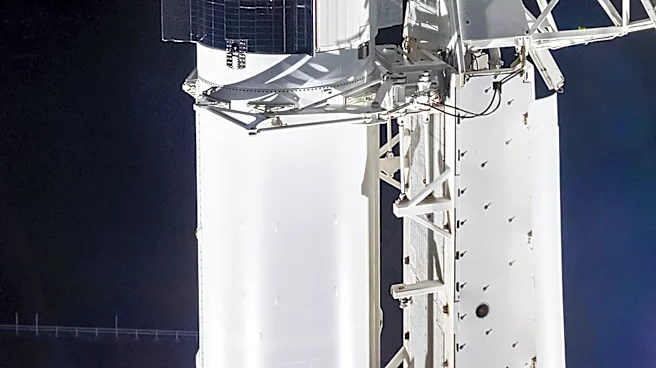
and private entities such as SpaceX, Anduril Industries, and Stripe. Founders Fund was an early institutional investor in Elon Musk’s SpaceX, and also backs Anduril Industries, a defense technology company founded by Palmer Luckey. Additionally, the firm holds a stake in Affirm, a fintech company founded by PayPal colleague Max Levchin, which is publicly traded on NASDAQ. Thiel's investment strategy, often described as 'hard tech' and 'contrarian,' focuses on companies with the potential to establish monopolies in their niches, emphasizing proprietary technology, network effects, and economies of scale. His portfolio also extends to biotechnology, with investments in companies like Unity Biotechnology, which focuses on longevity research.
Why It's Important?
Peter Thiel's investment philosophy and the strategic holdings of Founders Fund significantly influence the U.S. technology landscape. His focus on 'hard tech' and national security-oriented companies like Palantir and Anduril Industries underscores a broader shift in venture capital towards foundational infrastructure and defense modernization. The continued backing of SpaceX highlights the ongoing private sector-led innovation in aerospace, impacting U.S. capabilities in space exploration and satellite internet. Investments in fintech companies like Stripe and Affirm are crucial for the evolution of digital payments and consumer finance, shaping how businesses operate and consumers access credit. Thiel's influence, stemming from his 'PayPal Mafia' legacy, allows him to shape the trajectory of the tech industry by co-investing with former colleagues and making long-term, high-risk bets on transformative technologies.
What's Next?
Monitoring the 13F filings of Palantir Technologies and public disclosures from Founders Fund will be key to tracking Peter Thiel's evolving tech holdings. Given that many of his most valuable assets, such as SpaceX, Anduril, and Stripe, remain private, their ownership value will continue to be estimated based on the latest funding rounds. Thiel's continued advocacy for Bitcoin and his critical stance on 'altcoins' suggest ongoing engagement with the cryptocurrency market, potentially influencing future investment trends in digital assets. His focus on AI safety and infrastructure, beyond Palantir's Artificial Intelligence Platform, indicates a sustained interest in the ethical and foundational aspects of artificial intelligence development, which could lead to further investments in this sector.
Beyond the Headlines
Peter Thiel's investment strategy reflects a deeper philosophical outlook, particularly his view of death as a 'problem to be solved,' which drives his investments in longevity research through companies like Unity Biotechnology. His emphasis on 'monopolies' and 'contrarian' bets challenges conventional market wisdom, suggesting a belief that true innovation often arises from avoiding direct competition. The unique multi-class share structure in Palantir, granting founders collective voting power, highlights a desire for strategic control and long-term mission protection over short-term market pressures. This approach raises questions about corporate governance and the balance between investor returns and foundational vision. His pivot away from traditional 'Web 2.0' companies and his departure from Meta's board signal a broader skepticism towards the current social media paradigm, favoring 'hard' engineering and national sovereignty as key investment themes.