







What's Happening?
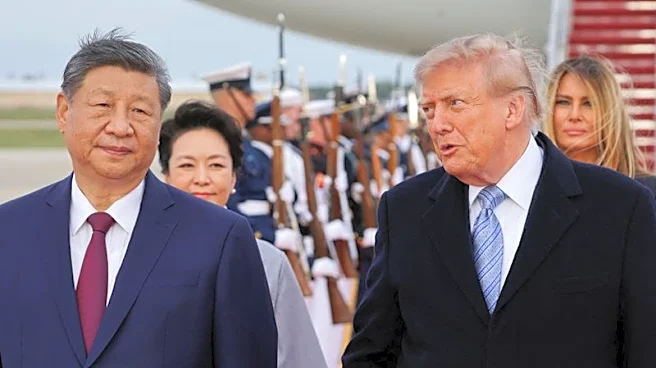
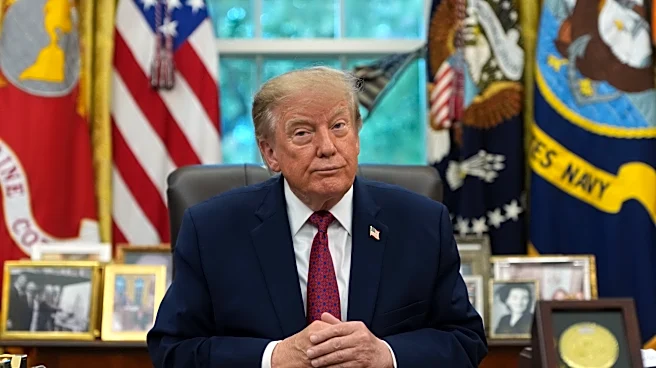
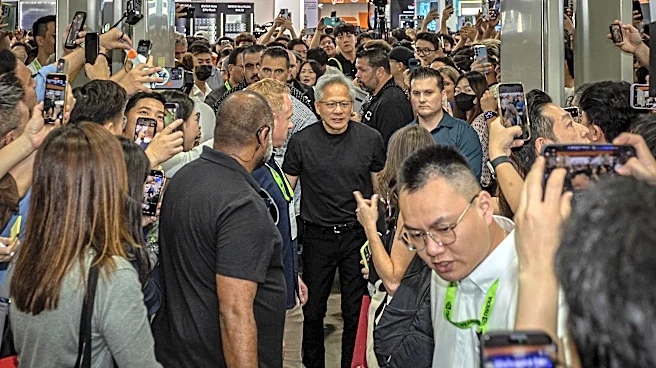
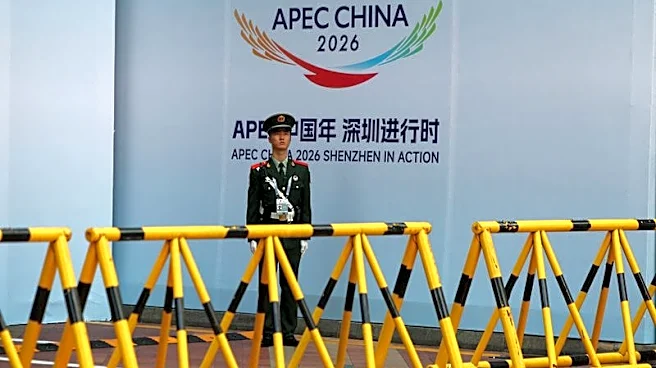
The recent Nvidia scandal has heightened trade tensions between the United States and China, casting a shadow over the upcoming bilateral meeting between President Trump and Chinese President Xi Jinping at the Asia-Pacific Economic Cooperation (APEC)
Leaders’ Meeting in Shenzhen. The controversy involves allegations of a Singapore-based cloud provider, Megaspeed, diverting restricted US semiconductors to China, which has raised concerns about the effectiveness of US export controls. This incident has prompted renewed calls from Congress and the Department of Commerce for stronger semiconductor controls. Representative John Moolenaar, chairman of the Select Committee on China, urged Congress to pass bipartisan export control legislation. The Commerce Department also released an interim final rule addressing remote access to computing power. These developments occur as both nations have reasons to maintain the trade truce established in October 2025, yet new restrictions continue to emerge from both sides, including China's rare earth export licensing requirements from April 2025.
Why It's Important?
The Nvidia scandal underscores the ongoing challenges in enforcing US export controls and preventing advanced technology from reaching China, which Washington views as a national security concern. The potential for tighter US restrictions on semiconductors could provoke retaliatory measures from Beijing, possibly through stricter controls on rare earth elements or the reinstatement of broader trade restrictions. China's dominance in rare earth supply chains gives it significant leverage, as these materials are crucial for semiconductor production, automobiles, and national defense. US manufacturers continue to face shortages of these critical materials, with imports from China not returning to pre-trade war levels. The situation highlights the vulnerability of US supply chains and the long-term strategic competition between the two economic powers, potentially jeopardizing cooperation in areas like AI Safety Dialogue or the Board of Trade.
What's Next?
The upcoming bilateral talks between President Trump and President Xi Jinping will be critical in navigating these escalating trade tensions. The fallout from the Nvidia scandal is galvanizing Congress and other US agencies to intensify oversight of trade and investment with China. Legislative efforts, including the AI Overwatch Act, the Chip Security Act, and the MATCH Act, are underway to strengthen semiconductor controls. If the US Congress proceeds with more semiconductor legislation, it could trigger a response from China, such as tighter rare earth controls or the reinstatement of previously suspended regulations that would restrict transfers of Chinese-made rare-earth refining equipment and extend export controls to foreign-made products containing Chinese-origin rare earths. Both leaders have an interest in preserving stable relations ahead of the December G20 Leaders’ Summit in Florida and through the trade truce's January expiration, but export controls are likely to become a major point of contention in 2027.
Beyond the Headlines
The deeper implications of the Nvidia scandal and the broader US-China trade dynamics reveal a complex interplay of economic competition, national security, and technological supremacy. The incident exposes the limitations of current export control regimes and the ingenuity of actors seeking to circumvent them. It also highlights the strategic importance of rare earth elements, positioning them as a critical geopolitical tool for China. The US efforts to diversify its critical mineral supply chains are long-term projects, meaning immediate leverage remains with China. This ongoing technological rivalry could reshape global supply chains, accelerate efforts towards technological decoupling, and force companies to re-evaluate their global operational strategies. The situation also tests the effectiveness of personal diplomacy in managing deep-seated strategic competition, suggesting that structural economic and security concerns may override individual leader agreements.