
What's Happening?
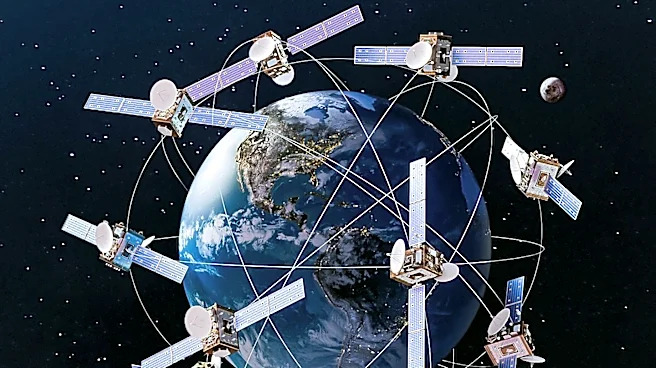
Elon Musk has revealed details about SpaceX's next-generation Starlink Mobile satellites, stating that Direct-to-Cell Version 2 will begin launching next year. This new constellation is projected to offer
40 times the bandwidth of the current Direct-to-Cell Version 1 satellites, a significant increase though lower than earlier claims of over 100 times the bandwidth. Additionally, SpaceX is developing a small, ground-based device designed to improve indoor coverage for Starlink Mobile. This device, similar to a Starlink dish, could be installed on a roof to help signals penetrate thick walls, addressing a key challenge for satellite-to-phone services. The device will utilize spectrum acquired by SpaceX in the 800 megahertz band and is expected to enter production next year. These developments aim to enhance Starlink's mobile capabilities and address limitations in signal penetration within buildings.
Why It's Important?
These advancements are crucial for expanding the reach and effectiveness of satellite-to-phone services in the U.S. The substantial increase in bandwidth with Direct-to-Cell Version 2 could significantly improve mobile internet speeds and reliability, making Starlink a more competitive option against traditional cellular providers. The introduction of a rooftop device to boost indoor signal penetration directly addresses a major hurdle for satellite communication, potentially eliminating 'dead zones' within buildings. This could broaden Starlink's appeal to a wider range of consumers and businesses, particularly in rural or underserved areas where traditional cellular infrastructure is lacking. For the telecommunications industry, this move signals increased competition, potentially pushing existing carriers to innovate further in coverage and service quality. The ability to provide robust indoor coverage could be a game-changer for Starlink's ambition to become a major U.S. phone carrier.
What's Next?
The launch of Starlink Direct-to-Cell Version 2 satellites is scheduled to begin next year, which will be followed by the phased deployment of the new constellation. Concurrently, the ground-based rooftop device designed to improve indoor signal penetration is also slated to enter production next year. These developments suggest that consumers could see enhanced Starlink Mobile services and improved indoor connectivity in the near future. SpaceX's continued acquisition of wireless spectrum, such as the 800 megahertz band, indicates further expansion of its mobile service capabilities. The company's progress will likely be closely watched by traditional U.S. mobile carriers, who may need to adapt their strategies to compete with Starlink's evolving offerings. The success of these new technologies will determine Starlink's trajectory in becoming a significant player in the U.S. mobile telecommunications market.
Beyond the Headlines
The strategic implications of these developments extend beyond mere technological upgrades. By addressing bandwidth limitations and indoor coverage issues, Starlink is positioning itself to disrupt the traditional U.S. telecommunications landscape. The ability to provide reliable mobile connectivity directly from satellites, augmented by ground-based repeaters, could fundamentally alter how internet and phone services are delivered, especially in remote or disaster-stricken areas. This could lead to a re-evaluation of infrastructure investment models for both satellite and terrestrial providers. Furthermore, the increased competition could drive down costs for consumers and accelerate innovation across the industry. The long-term vision of ubiquitous connectivity, even in previously inaccessible locations, raises questions about digital inclusion and the potential for new economic opportunities in underserved regions. The integration of satellite and terrestrial technologies also hints at a future where hybrid networks become the norm, offering greater resilience and coverage.