





What's Happening?
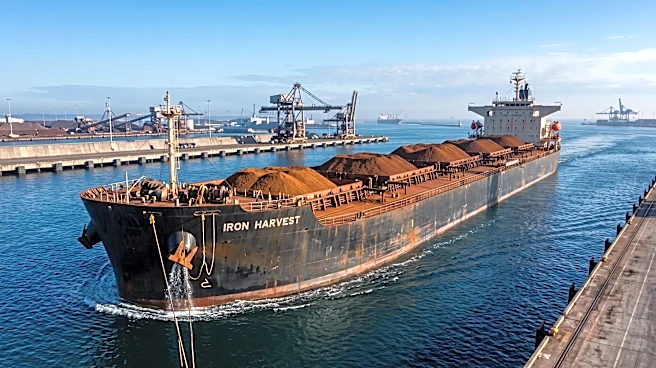
Guinea's Simandou iron-ore project, a joint venture involving Rio Tinto Group and Aluminum Corporation of China, has shipped its first cargo to a European customer. A vessel named Tower Point departed Morebaya port on November 23, carrying 79,081 tons
of Simandou Fines destined for Dunkirk, France, with an expected arrival in early December. This shipment marks a significant milestone as it is the first export from the project to a country outside China, which has been the primary destination for Simandou's high-grade ore. European steelmaker ArcelorMittal SA, which operates a plant in Dunkirk, is the recipient of this initial European cargo. The Simandou project has been ramping up production throughout the year, aiming for an annual capacity of 120-million tons, with monthly exports exceeding 5-million tons in October.
Why It's Important?
This development signifies a crucial diversification of the Simandou project's export markets beyond China, potentially reducing reliance on a single major buyer. For European steelmakers like ArcelorMittal, access to Simandou's high-grade ore, which is well-suited for low-emissions steelmaking, could support their efforts to decarbonize production and meet environmental targets. The increased supply of high-quality iron ore to the global market could also influence international iron ore prices and supply dynamics. While the immediate impact on U.S. industries might be indirect, a more diversified global iron ore market could contribute to greater stability in raw material costs for steel-dependent sectors worldwide, including those with U.S. operations or supply chains. The project's continued ramp-up and expansion of its customer base could also foster greater competition among iron ore suppliers.
What's Next?
Following this initial shipment, another cargo is being loaded onto the True Caspian for delivery to Gijon, Spain, where ArcelorMittal also operates a major steelmaking facility. This indicates a continued strategy to expand Simandou's presence in the European market. The project is steadily progressing towards its annual capacity target of 120-million tons, suggesting a sustained increase in iron ore supply. Future developments will likely involve further agreements with European and potentially other international steelmakers as the project continues to scale up. The long-term impact will depend on the consistency of supply, the evolving demand for low-emissions steel, and the geopolitical landscape influencing global trade routes and commodity markets.
Beyond the Headlines
The Simandou project's ability to diversify its customer base beyond China highlights a broader trend in global commodity markets where producers are seeking to mitigate risks associated with over-reliance on single markets. This move could also be seen in the context of global efforts to reduce carbon emissions, as high-grade iron ore is crucial for more efficient and environmentally friendly steel production processes. The involvement of major international mining and steel companies underscores the strategic importance of securing access to high-quality raw materials for future industrial development. The project's success in establishing new export routes could set a precedent for other large-scale resource projects looking to optimize their market reach and resilience.