






What's Happening?
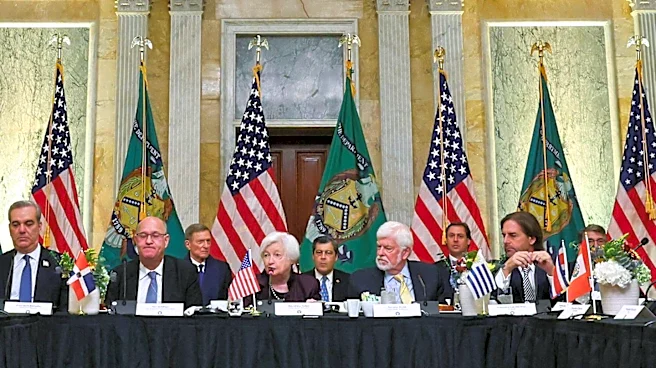
U.S. Senator Bill Hagerty, Chancellor Daniel Diermeier, and Japanese Ambassador to the United States Shigeo Yamada recently engaged in a discussion regarding Nashville's increasing capacity to attract global investment. This discussion took place at the Southeast
U.S.-Japan (SEUS) Annual Joint Meeting. Ambassador Yamada highlighted Nashville's rapidly expanding innovation capabilities, including its startups, university research, and ability to translate ideas from laboratories into practical applications. He noted that Nashville's innovation ecosystem is becoming increasingly competitive with coastal regions. Ambassador Yamada emphasized the need to better communicate Nashville's story to a broader audience to fully capitalize on its potential. Vanderbilt University played a significant role as a leading sponsor of the conference, underscoring its commitment to fostering the relationship between Japan and the Southeast U.S.
Why It's Important?
This discussion is important for the U.S. economy, particularly for the Southeast region and Nashville. The focus on attracting global investment and corporate research and development (R&D) signifies a strategic effort to boost economic growth and job creation. By highlighting Nashville's innovation capacity, the participants are positioning the city as a key player in the global market, potentially drawing in foreign capital and expertise. The emphasis on university research and startups indicates a commitment to fostering a knowledge-based economy, which can lead to long-term economic stability and competitiveness. The involvement of a U.S. Senator and the Japanese Ambassador underscores the diplomatic and economic ties between the two nations, suggesting a concerted effort to strengthen these relationships for mutual benefit. Increased global investment can lead to new industries, technological advancements, and a more diversified economy for the region.
What's Next?
Following this discussion, there is an anticipated push to further promote Nashville's innovation ecosystem and hospitality to attract more global investment and corporate R&D. Vanderbilt University's initiatives, such as the Nashville Innovation Alliance and the 'Cowrite the Future' campaign, are expected to play a crucial role in this effort. The challenge articulated by Ambassador Yamada—to better tell Nashville's story—suggests that future efforts will likely involve targeted marketing and outreach campaigns to international investors and corporations. Continued collaboration between academic institutions, local government, and international partners will be essential to translate these discussions into tangible economic benefits. The ongoing relationship between Japan and the Southeast U.S., supported by events like the SEUS Annual Joint Meeting, will likely see further initiatives aimed at strengthening economic and cultural ties.
Beyond the Headlines
The emphasis on Nashville's 'hospitality, strengthened by an incredible food and entertainment scene' alongside its innovation ecosystem reveals a broader strategy for economic development. This approach recognizes that quality of life and cultural vibrancy are increasingly important factors for attracting global talent and investment, beyond just economic incentives. It suggests a shift towards a more holistic view of urban development, where a city's appeal is multifaceted. The collaboration between a U.S. Senator, a university chancellor, and an international ambassador also highlights the growing importance of public-private partnerships and international diplomacy in fostering regional economic growth. This model could serve as a blueprint for other U.S. cities looking to enhance their global competitiveness by leveraging both their economic strengths and cultural assets.