







What's Happening?
Actress and musician Charlotte Gainsbourg has recently discussed her evolving relationship with photography and memory, particularly in the context of her exhibition '5bis.' This exhibition features photographs she took of her late father, Serge Gainsbourg's,
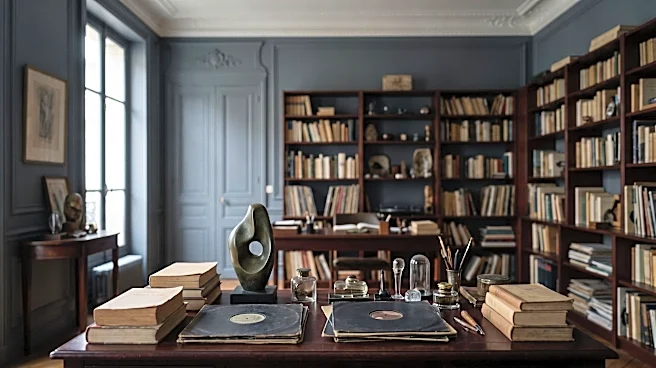
long-preserved Paris home. Gainsbourg captured these images during her final private moments in the house before it was opened to the public, describing the process as emotionally driven rather than intended for registration. The photographs, which had been stored on her computer for years, gained new life and purpose when they were printed for the Arles exhibition. The exhibition, named after Serge's home address, was organized in partnership with Saint Laurent and Maja Hoffmann. Gainsbourg notes that every object in her father's house feels like a part of him, and she does not isolate them from his vision, story, or how the house evolved over the years he lived there. She views each object as a piece of him, holding onto everything she can since his passing 35 years ago.
Why It's Important?
Charlotte Gainsbourg's '5bis' exhibition offers a profound exploration of personal memory, grief, and the public's relationship with cultural icons. By photographing her father's home, she transforms a private space into a public narrative, allowing audiences to connect with the legacy of Serge Gainsbourg through an intimate lens. This project highlights the power of photography as a medium for processing emotion and preserving history, particularly when dealing with the memory of a beloved figure. The exhibition's success, evidenced by people queuing in front of the house, demonstrates the enduring public fascination with the lives of artists and the spaces they inhabit. It also underscores the complex dynamic between an artist's personal life and their public persona, and how family members navigate this boundary. Gainsbourg's decision to share these deeply personal images provides a unique perspective on her father's world, enriching the public's understanding of his artistic and personal life, and offering a poignant reflection on the passage of time and the permanence of memory.
What's Next?
Charlotte Gainsbourg's exhibition '5bis' has already been organized and presented, with the photographs printed for Arles. The public's positive reception, as indicated by queues at Serge Gainsbourg's house, suggests a continued interest in the project. While the immediate next steps for this specific exhibition are not detailed, the conversation implies an ongoing engagement with the themes of photography, memory, and her father's legacy. Gainsbourg's reflection on the shift from private moments to public display suggests a new phase in her relationship with her father's memory and the house. Future developments could include further exhibitions, publications of the photographs, or perhaps even more artistic endeavors that delve into her family's history and her personal connection to it. Her statement about fighting for the project's existence for over 30 years indicates a deep commitment that may lead to further explorations of this subject matter.
Beyond the Headlines
The '5bis' exhibition transcends a simple display of photographs; it delves into the ethical and emotional complexities of memorializing a public figure through their private spaces. Charlotte Gainsbourg's act of photographing her father's home before its public opening can be seen as a form of reclaiming intimacy, a final private communion before the space becomes a shared cultural artifact. This raises questions about ownership of memory and the transformation of personal grief into collective heritage. The exhibition also highlights the role of objects as conduits of memory, where each item in Serge Gainsbourg's house is imbued with his presence, becoming a 'portrait through objects.' This approach challenges conventional biographical narratives by focusing on the material culture of a life lived. Furthermore, the collaboration with Saint Laurent and Maja Hoffmann suggests a convergence of art, fashion, and cultural preservation, indicating how different sectors can contribute to the interpretation and presentation of artistic legacies. The project ultimately serves as a powerful testament to the enduring impact of an artist and the intricate ways their memory is preserved and reinterpreted across generations.