

What's Happening?
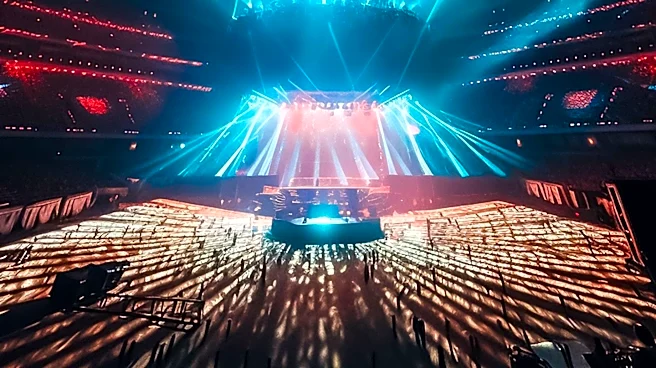
Jimmy Eat World is currently on a 25th-anniversary tour celebrating their album 'Bleed American,' performing across the United States, Canada, and the United Kingdom. The tour features sophisticated audio engineering led by Travis Bing at front of house
and Scott 'Shreddy' Edwards at monitors. Bing, who joined the band in 2024, utilizes a Digico Quantum 326 console, Waves SuperRack, and a selection of outboard gear including an SSL Fusion and a Neve Master Bus Processor. Edwards, on monitors since summer 2023, employs a Digico Quantum 225, Shure PSM1000s, and a Shure AD600 Axient Digital Spectrum Manager. Both engineers have implemented specific strategies to maintain the band's desired sound, with Bing focusing on preserving sonic differences between albums and Edwards prioritizing clean, flat mixes for the band members. The tour also features a new sE Electronics microphone package for the drum kit, chosen for its consistent sound quality.
Why It's Important?
The meticulous audio engineering on Jimmy Eat World's 25th-anniversary tour highlights the critical role of sound professionals in delivering high-quality live music experiences. The use of advanced digital consoles and specialized outboard gear by Travis Bing and Scott Edwards ensures that the band's sound is faithfully reproduced and optimized for diverse venues. Bing's approach to differentiating the sonic profiles of 'Clarity' and 'Bleed American' demonstrates a deep understanding of artistic intent and technical execution, crucial for fan engagement and critical reception. Edwards' focus on clean monitor mixes directly impacts the band's performance, allowing musicians to hear themselves accurately and perform at their best. This level of technical precision is vital for maintaining a band's reputation and ensuring a memorable experience for audiences, underscoring the significant investment in audio technology and expertise within the live music industry.
What's Next?
Jimmy Eat World's 'Bleed American' 25th-anniversary tour is scheduled to conclude this fall with a series of shows in the United States and Australia. Following the tour, the band and their audio engineers will likely evaluate the performance of their current audio setup and strategies. The insights gained from this extensive tour, particularly regarding the effectiveness of the new microphone package and the specific mixing techniques employed, could influence future touring decisions and studio recordings. The continued evolution of audio technology, such as the use of digital clocks like the Apogee Big Ben Master Digital Clock for improved sound alignment, suggests that engineers will continue to explore new tools to enhance live sound. The success of this tour in delivering a high-fidelity experience will likely reinforce the importance of skilled audio professionals and advanced equipment in the music industry.
Beyond the Headlines
The technical sophistication behind Jimmy Eat World's tour reflects broader trends in the live music industry, where sound engineering has become an increasingly specialized and critical field. The engineers' detailed explanations of their gear and mixing philosophies, such as Bing's intentional use of plugins and Edwards' preference for flat mixes, offer a glimpse into the artistry and scientific precision involved in live sound. This level of detail underscores the shift from purely analog setups to integrated digital and analog systems, allowing for greater control and customization. The collaboration between engineers and the band to achieve a specific sonic outcome also highlights the symbiotic relationship between artistic vision and technical execution. This continuous pursuit of sonic excellence not only elevates the concert experience for fans but also pushes the boundaries of what is possible in live audio production, influencing equipment development and engineering practices across the industry.