



What's Happening?
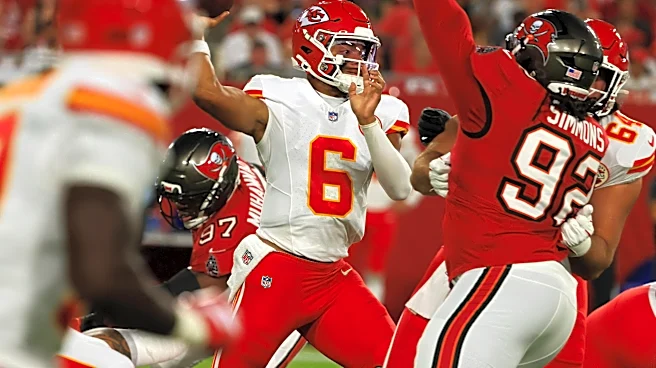
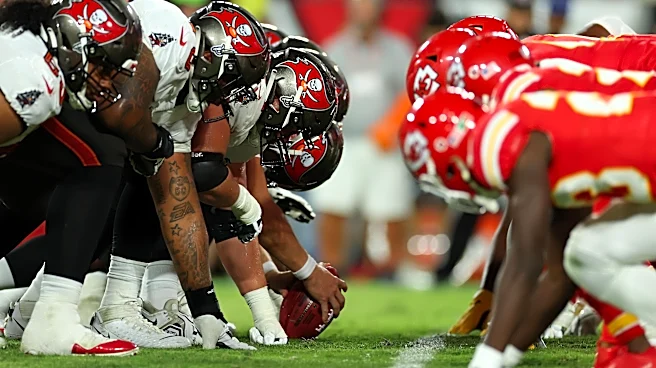
Tampa Bay Buccaneers running back Bucky Irving has reportedly gained 10 pounds, bringing his current weight to an unspecified amount above his 2024 NFL Scouting Combine weight of 192 pounds. This development was noted during the WFLA-TV broadcast of the Buccaneers'
preseason game against the Kansas City Chiefs. While the exact timing of the weight gain is not specified, it is presumed to have occurred since the end of the last season. In the recent preseason game, Irving rushed for 14 yards on three attempts. The impact of this weight gain on his performance is a subject of discussion, with some past examples of Buccaneers running backs showing improved performance after losing weight, such as Rachaad White and Peyton Barber. Conversely, some speculate the added weight could be beneficial for absorbing impact over a longer season.
Why It's Important?
This weight gain for Bucky Irving is significant for the Tampa Bay Buccaneers as it could directly influence his effectiveness and role within the team's offensive strategy. Historically, several Buccaneers running backs, including Rachaad White and Peyton Barber, have seen improved explosiveness and overall performance after reducing their weight. For instance, White dropped 9 pounds before last season and increased his average yards per carry. Doug Martin also had an All-Pro season after losing 20 pounds. If Irving's added weight hinders his agility or speed, it could impact his ability to contribute effectively, potentially shifting his usage or the team's reliance on other running backs. Conversely, if the weight is muscle, it could enhance his durability and ability to break tackles, which would be a positive for the team's ground game over a demanding 17-game season.
What's Next?
The immediate focus will be on Bucky Irving's performance in upcoming preseason games and the start of the regular season. Coaches and analysts will closely monitor how the added weight affects his speed, agility, and ability to absorb contact. His snap count and efficiency in carries will be key indicators. The Buccaneers' coaching staff will likely evaluate whether the weight gain is beneficial for his overall durability and power, or if it detracts from his elusiveness. Depending on his performance, the team might adjust his role, potentially splitting carries more evenly with other running backs if the weight is deemed detrimental, or increasing his workload if it proves advantageous. The ongoing discussion among fans and analysts will continue as more game film becomes available.
Beyond the Headlines
The debate surrounding Bucky Irving's weight gain highlights a broader strategic consideration in professional football: the optimal physical conditioning for running backs. This isn't just about raw weight but the composition of that weight (muscle vs. fat) and its impact on a player's specific skill set. For running backs, there's a delicate balance between power, necessary for breaking tackles and short-yardage situations, and agility/speed, crucial for open-field running and elusiveness. Irving's situation could serve as a case study on how individual player development, influenced by NFL training facilities and nutritional programs, can alter a player's physical profile and subsequent on-field performance. It also underscores the continuous adaptation required in professional sports, where physical attributes are constantly fine-tuned to maximize competitive advantage.